Monday, June 11, 2012

Enneagram and Spiritual Direction

The enneagram is a psycho-spiritual tool for determining personality types for the purpose of spiritual and psychological growth. Its origin remains unknown though there are claims that it link back to Evagrius, one of the Desert Fathers. However there are also claims that it has its origins with the ancient Greek philosophers such as Pythagoras. There are also claims that it draws from Kabbalistic teachings, and Sufism. The modern enneagram has been popularised by George Gurdjieff, Oscar Ichazo, Helen Palmer, and Richard Rohr. An interesting overview of the traditional enneagram may be found here from the Enneagram Institute.

The followings links from the International Enneagram Association (IEA) website gives a brief overview of the enneagram system:

Personality Defined
Read a brief definition of what is meant by the word personality.

The Three Centers of Intelligence: Head, Heart, and Body
This provides a brief description of the Three Centers of Intel-ligence -- three different ways of perceiving the world and experience -- and how each of the nine types is based on one of these three centers.

Enneagram Wings: The Types Adjacent to Your Enneagram Type
The Enneagram wings are the types on either side of your core type that can affect the way your personality is expressed.

Security and Stress Points: The Interconnecting Arrows
The Enneagram Stress and Security Points are the two types on the interior lines to your core type. These two types can also affect the way your personality is expressed.

Enneagram Subtypes: Self-preservation, One-on-one, and Social
Whatever your type, your personality expression will also be affected by whether your subtype is self-preservation (focusing on self-survival and protection), one-on-one (focusing on close relationships with another person), or social (focusing on social groups).

Descriptions of the Nine Enneagram Personality Types
Each of the nine Enneagram types is described in detail. This includes each type’s focus of attention, coping strategy, major traits, strengths, and challenges.

Is there a place for the enneagram in Christian spiritual direction? 


James Empereur. S.J. who taught Liturgical and Systematic Theology at the Jesuit School of Theology and Graduate Theological Union attempts to address this question in his 2007 book, The Enneagram and Spiritual Direction: Nine paths to spiritual guidance. Empereur defines spiritual direction as

The process in which a Christian accompanies others for an extended period of time for the purpose of
clarifying the psychological and religious issues in the directees so that they may move toward deeper union with God and contribute
to ministry within the Christian community (43).

In using the enneagram as a tool for spiritual direction, Empereur argues that it is useful to help people to focus their attention on their feelings and their thoughts. It also offers people opportunities to explore ‘spaces’ in other personality types which they would otherwise not know. He notes,

Preliminary to much spiritual growth is the ability to know how and when the attention shifts among thought,
memory, and planning and among fantasy, feeling, and sensation;
also necessary is the knowledge of how to visit the other spaces on
the enneagram besides one's own to experience other styles of attention. (12)

However he deviates from the standard teachings of other enneagram practitioners by offering his own interpretation of the system. On the movement on the arrow with regards to stress and security points, he argues from more freedom that comes from choosing.

I prefer to understand the arrow theory as having to do with
way we choose to grow. That is, in times of stress, one can move
toward one's stress point in order to gain certain energies to move
forward while in times of relative calm, there are qualities in the
security point that one can utilize to further one's journey. (16)

This argument becomes more pronounced when he argues for more freedom in the enneagram system theory itself. He felt that the theory is too rigid and does not allow the element of ‘freewill’ or choice.

Rather I see healthy and holy persons as those who have
integrated their own space into their lives by moving to both stress
and security spaces, by picking up there whatever is useful for their
growth at any moment of their personal journey, by drawing strength
from both wings, by depending on the need at hand, as well as
by being able to visit all the spaces on the enneagram as required
or desired at any moment of their lives. Thus, healthy persons
those who move around the enneagram at choice. They always
main firmly based in their own space, where their principal energy is
found. But they are not limited in their journey to leaning on one
or both of their wings, nor are they required to move in one or other
direction such as the 1-4-2-8-5-7 internal structure. Rather they
can visit all the spaces at different times depending on their changing
circumstances. (20)

Empereur seems to be willing to use the enneagram in spiritual direction but he has modified and changed it in order for it to be 'Christian' which makes it very different from the models Helen Palmer, the Enneagram Institue and the International Enneagram Association proposed. In fact, there is so much variation in the different models that no one can be sure which one is the right one.

Another important observation is that after three decades of enneagram literature, there is still lack of sufficient scientific data to support its claims of describing personality types.

It is also worth noting in the section of Enneagram of Personality in Wikipedia, there is this concluding paragraph:
In 2000, the United States' Committee on Doctrine produced a draft report on the origins of the Enneagram to aid bishops in their evaluation of its use in their dioceses. The report identified aspects of the intersection between the Enneagram and Catholicism which, in their opinion, warranted particular scrutiny and were seen as potential areas of concern, stating that "While the enneagram system shares little with traditional Christian doctrine or spirituality, it also shares little with the methods and criteria of modern science... The burden of proof is on proponents of the enneagram to furnish scientific evidence for their claims."[20] Partly in response to some Jesuits and members of other religious orders teaching a Christian understanding of the Enneagram of Personality, a 2003 Vatican document called Jesus Christ, the Bearer of the Water of Life. A Christian Reflection on the 'New Age' says that the Enneagram "when used as a means of spiritual growth introduces an ambiguity in the doctrine and the life of the Christian faith."[21][22]

Labels: ,

Monday, March 12, 2012

Rest in God's Heart


I slept, but my heart was awake. (Song of Solomon 5:2 RSV)

Our sleep will be peaceful when we rest in God's heart, abandoning ourselves to his providence and ever maintaining a sweet awareness of his mercy. When we do this, we are no longer seeking anything for ourselves, and our entire
being rests in him.

What we leave behind are our faltering and troubled rationalizations, our desires for ourselves, our impatience to gain a higher place. Then we find ourselves resting in the heart of God—for God is the one who has put us
there with his own hands, and he cradles us there in his arms. Can we be in danger where God places us—a place where we are as a little child who is rocked and hugged by its mother? Let us let go and give him the freedom to act. Let us rest on him and in him.

This confident, trusting rest, which quells every movement of our limited human reasoning, comes as we maintain true vigilance over our hearts. To place ourselves in God’s hands without leaning on any person or any thing—this is what it is to keep our hearts awake even as we sleep.

In this way love will always jealously keep its eyes open; it will always reach out to its Beloved. And when we do that we will not fall into the deadly sleep of our souls.

 
Francois Fenelon
Meditations on the Heart of God

Labels: ,

Sunday, February 19, 2012

When You are Old

WHEN YOU ARE OLD
by: William Butler Yeats (1865-1939)
      HEN you are old and grey and full of sleep,
      And nodding by the fire, take down this book,
      And slowly read, and dream of the soft look
      Your eyes had once, and of their shadows deep;
       
      How many loved your moments of glad grace,
      And loved your beauty with love false or true,
      But one man loved the pilgrim soul in you,
      And loved the sorrows of your changing face;
       
      And bending down beside the glowing bars,
      Murmur, a little sadly, how Love fled
      And paced upon the mountains overhead
      And hid his face amid a crowd of stars.
"When You Are Old" is reprinted from The Rose. W.B. Yeats. 1893.

Labels: , ,

Friday, June 17, 2011

Thomas Merton The Serene Disciple


When in the Soul of the Serene Disciple

When in the soul of the serene disciple
With no more Fathers to imitate
Poverty is a success,
It is a small thing to say the roof is gone:
He has not even a house.

Stars, as well as friends,
Are angry with the noble ruin.
Saints depart in several directions.

Be still:
There is no longer any need of comment.
It was a lucky wind
That blew away his halo with his cares,
A lucky sea that drowned his reputation.

Here you will find
Neither a proverb nor a memorandum.
There are no ways,
No methods to admire
Where poverty is no achievement.
His God lives in his emptiness like an affliction.

What choice remains?
Well, to be ordinary is not a choice:
It is the usual freedom
Of men without visions

                                                                           Thomas Merton

Labels: , , ,

Tuesday, December 21, 2010

PhD Research Scholarship in Glouchester

RESEARCH STUDENTSHIP IN THE BIBLE AND SPIRITUALITY
Dept of Humanities
University of Gloucestershire

The Department proposes to offer a studentship for a PhD in the area
of the Bible and Spirituality. The studentship will be held within a
three-year project sponsored by the Department’s Research Centre for
the Bible and Spirituality in conjunction with the Bible Society. Its
aim is to explore forms of spirituality that find expression in the
Bible, and the relation of these to other contemporary concepts of
spirituality.

The studentship, which is designed to cover a substantial part of the
student’s costs, may be awarded to a suitably qualified candidate who
proposes to work in any area of biblical spirituality, Old Testament
or New Testament, within the terms of the project. The studentship
will begin in February or September 2011, and is renewable annually.
Further details are available on request from:

Mrs Patricia Downes
Humanities Courses Administrator
University of Gloucestershire
Francis Close Hall
Swindon Road
Cheltenham
GL50 4AZ

Tel: 01242 714570
pdownes@glos.ac.uk

Labels: , ,

Thursday, November 04, 2010

Rumi’s "The Guest House"


This being human is a guest house.
Every morning a new arrival.
A joy, a depression, a meanness,
some momentary awareness comes
as an unexpected visitor.
Welcome and entertain them all!
Even if they’re a crowd of sorrows,
who violently sweep your house
empty of its furniture,
still, treat each guest honorably.
He may be clearing you out
for some new delight.
The dark thought, the shame, the malice,
meet them at the door laughing,
and invite them in.
Be grateful for whoever comes,
because each has been sent
as a guide from beyond.

—translated by Coleman Barks

Labels: , ,

Wednesday, September 15, 2010

Contemplative in Actions


I have been reading James Martin SJ 's wonderful book The Jesuit Guide to (Almost) Everything: A Spirituality for Real Life for my online Book Discussion Group. James Martin is an excellent writer with the ability to poke fun at himself and his order, The Society of Jesus or the Jesuits. The SJ which comes after his name stands for Society of Jesus (SJ) but also as he relates it was applied to him as Stupid Jerk!

Basically the book is an overview of Ignatian spirituality. He defines Ignatian spirituality as
1. Finding God in all things
2. Becoming a contemplative in action
3. Looking at the world in an incarnational way
4. Seeking freedom and detachment
which is an excellent summary of the main teachings of the Jesuits.

With no offense to the Jesuits, I always think that it should be "contemplative in actions" rather than "becoming a contemplative in action." I guess it is a matter of which is the object and which is the subject or which is the one where the emphasis is. I can understand why the Jesuits chose "contemplative in action" because of the misconceptions that contemplatives are navel gazers who does not contribute to the real world by being involved in real "action". Contemplatives are those who are closeted in the monasteries, protected by thick walls from the corrupting influences of the unwashed masses and spend their time in beautific communion with God.

That is a misconception of contemplatives. First a definition. A contemplative is a person whose inner life is lived focused on God with imputed grace resulting in love overflowing into every aspect of their being. Note the definition does not specify where the contemplative lives. That person may live in a monastery or with 7 million other persons on the tiny island of Singapore. Not all contemplatives are insulated from the mainstream of human life. I am always inspired by the examples of contemplatives like Bernard of Clairvaux who started hundreds of monasteries, became a Doctor of the Chruch, advised Popes and even started the Second Crusade, and Thomas Merton who became an anti-war activist, ecumenist and spiritual writer. So the focus on the contemplative seem to imply that the Jesuits are encouraging contemplatives to be involved in "action."

However, not all of us are contemplatives. Many of us, by temperament are activists. We are trees cutters rather than navel gazers. Hence "contemplative in actions" where the emphasis is on the "actions." We can act contemplatively rather than be contemplatives who acts. Another definition: a contemplative action is one that is done to please God and to fulfill his perfect will. This action may be something "spiritual" or "religious" or as simple as making a cup of coffee. God created coffee and who is to say that He does not have pleasure in seeing his creature enjoying the aroma of a full-bodied dark coffee?

Now where is my coffee?

.

Labels: , , , ,

Tuesday, August 31, 2010

Confucian Spirituality

Tu Wei-Ming was born in mainland China, studied in Taiwan, and pursued an academic career at Princeton and UC Berkeley. Now a professor of Chinese history and philosophy at Harvard University, he teaches and writes about Confucianism. He is a proponent of "the theory of Cultural China," an attempt to be Chinese within a global context.

Labels: , ,

Saturday, August 14, 2010

To Invoke a Blessing

Invoke a Blessing

What is a blessing? A blessing is a circle of light drawn around a person to protect, heal, and strengthen. Life is a constant flow of emergence. The beauty of blessing is its belief that it can affect what unfolds.

To be in the world is to be distant from the homeland of wholeness. We are confined by limitation and difficulty. When we bless, we are enabled somehow to go beyond our present frontiers and reach into the source. A blessing awakens future wholeness. We use the word foreshadow for the imperfect representation of something that is yet to come. We could say that a blessing "forebrightens" the way. When a blessing is invoked, a window opens in eternal time. . . .

We never see the script of our lives; nor do we know what is coming toward us, or why our life takes on this particular shape or sequence. A blessing is different from a greeting, a hug, a salute, or an affirmation; it opens a different door in human encounter. One enters into the forecourt of the soul, the source of intimacy and the compass of destiny.

Our longing for the eternal kindles our imagination to bless. Regardless of how we configure the eternal, the human heart continues to dream of a state of wholeness, a place where everything comes together, where loss will be made good, where blindness will transform into vision, where damage will be made whole, where the clenched question will open in the house of surprise, where the travails of a life's journey will enjoy a homecoming. To invoke a blessing is to call some of that wholeness upon a person now.

— John O'Donohue in To Bless the Space Between Us


.

Labels:

Saturday, August 07, 2010

Candlelight Perception


Practice Candlelight Perception

The light of modern consciousness is not gentle or reverent; it lacks graciousness in the presence of mystery; it wants to unriddle and control the unknown. Modern consciousness is similar to the harsh and brilliant white light of a hospital operating theatre. This neon light is too direct and clear to befriend the shadowed world of the soul. It is not hospitable to what is reserved and hidden. The Celtic mind had a wonderful respect for the mystery and depth of the individual soul.

The Celts recognized that the shape of each soul is different; the spiritual clothing one person wears can never fit the soul of another. It is interesting that the word revelation comes from re-valere, literally, "to veil again." The world of the soul is glimpsed through the opening in a veil that closes again. There is no direct, permanent, or public access to the divine. Each destiny has a unique curvature and must find its own spiritual belonging and direction. Individuality is the only gateway to spiritual potential and blessing.

When the spiritual search is too intense and hungry, the soul stays hidden. The soul was never meant to be seen completely. It is more at home in a light that is hospitable to shadow. Before electricity, people used candlelight at night. The ideal light to befriend the darkness, it gently opens up caverns in the darkness and prompts the imagination into activity. The candle allows the darkness to keep its secrets. There is shadow and color within every candle flame. Candlelight perception is the most respectful and appropriate form of light with which to approach the inner world. . . . Candlelight perception has the finesse and reverence appropriate to the mystery and autonomy of soul.

— John O'Donohue in Anam Cara

Labels: , , , ,

Wednesday, July 28, 2010

McColman on Ordinary and Extraordinary Mysticism

Carl McColman whose The Big Book of Christian Mysticism I am impatiently waiting to arrive so that I can read it on the long plane ride to South Africa defines "ordinary" and "extraordinary" mysticism in his blog post here. I find his definitions very illuminating and similar to my own perspective. This is especially useful for Evangelicals who for some unknown reasons find mysticism threatening.

  • Ordinary Mysticism is what I understand Rahner to mean when he says “the Christian of the future will be a mystic or will not exist at all.” This is, in essence, an experiential spirituality which seeks union with God, in the heart of the mystery of God, which transcends a merely rational or intellectual relationship with God. This mysticism basically has three characteristics: it aims for, and hopes for, the felt experience and conscious awareness of the presence of God, and union with God. But of course, since such experience can only by the gift of God, the seeker must recognize that sometimes God is “known” only in darkness or unknowing — the felt experience of the seeming absence of God. This is where faith is essential, for only a lively and well-nurtured faith can sustain the seeker through times when God seems absent. In addition to experience and faith, the third element of ordinary mysticism is practice: the disciplined engagement with historically recognized spiritual practices, including lectio divina, meditation, prayer, and contemplation, which do not cause the experience of God, but dispose the seeker to be open and receptive to receive whatever experience God may choose to bestow. One who engages in such practices can be called a “contemplative,” even though the highest, most mystical form of contemplation is, itself, purely a gift from God.
  • Extraordinary Mysticism, like ordinary mysticism, entails the conscious awareness of the presence of God, and/or sustaining faith in God’s presence even when only aware of God’s seeming absence, and a life ordered to spiritual practices aimed at fostering greater intimacy with God. However, it is extraordinary in the sense that the mystic experiences phenomena or events that cannot be explained by ordinary human science: such as miraculous healings, visions, locutions, levitation, the ability to survive on no food other than the Eucharist, the stigmata, and the body remaining incorrupt after death. Such phenomena, of course, is controversial, and many devout Christians may remain skeptical about such things. I would argue that even a person who is skeptical about allegedly supernatural phenomena may still be an “ordinary” mystic.

I strongly hold that mysticism has a place in Christian spirituality because mysticism prevents Christians from placing God in a box.

.

Labels: , ,

Wednesday, July 14, 2010

Standing at Crossroads


Crossroads are busy places. They are chaotic places of noise and busyness. Often at the junction of four or five feeder roads, crossroads are where the traffic of people and cars merge and disengage, for a fleeting moment meeting, and then going their separate ways. Many of us find ourselves standing at crossroads, some more frequent than others, at different times in our lives. We stand in the chaos, amidst the noise, confusion and uncertainty, as we scan the various roads that lead away to decide which one to follow. Crossroads are places of decisions. They are scary places because we know decisions have consequences.

How do we find our way out of the crossroads of our lives? Jeremiah the prophet offers a profound advice from the Lord. Addressing the people of Judah who had lost their way at the crossroads of idolatry, religiosity and self-interest, Jeremiah suggests that that they
"stand at the crossroads and look;
ask for the ancient paths,
ask where the good way is,
and walk in it,
and you will find rest for your souls..." (Jer 6:16).
In the hectic pace of modern techno-culture, often we struggle to find the "one thing needful" and not be carried away by the tsunami of change that engulf us and carry us along in its flow. We must to look around our crossroads, looking for the ancient paths, the good way, that will leads us to the "one thing needful" and find rest for our souls. The "one thing needful" in our lives is to sit at the feet of Jesus: To behold his glory and bask in his presence. Our souls need rest. Our souls need healing. Our souls need refreshing. The aridity in our souls needs the "living water" of Jesus Christ.

I enjoy the songs of Don McLean. One of his more famous songs is American Pie. However there are many of his other relatively unknown songs that have made an impact upon me. One of them is "Crossroads" from his 1971 American Pie album.

"But there’s no need for turning back
`cause all roads lead to where I stand.
And I believe I’ll walk them all
No matter what I may have planned.

Can you remember who I was? Can you still feel it?
Can you find my pain? Can you heal it?
Then lay your hands upon me now
And cast this darkness from my soul.
You alone can light my way.
You alone can make me whole once again."

The lyrics and music spoke to me of the times when I had found myself at crossroads: Of the pain, the hurts, the uncertainties, and the loneliness. It also reminded me that at these times, I do not stand alone. Jesus has always been there with me, supporting me and tending to my wounds. "Ask for the ancient paths, ask where the good way is, and walk in it, and you will find rest for your souls" Sound advice of an ageless truth.


Kyrie eleison


Labels: , ,

Friday, July 09, 2010

The Inner Wellspring

You can never love another person unless you are equally involved in the beautiful but difficult spiritual work of learning to love yourself. There is within each of us, at the soul level, an enriching fountain of love. In other words, you do not have to go outside yourself to know what love is. This is not selfishness, and it is not narcissism; they are negative obsessions with the need to be loved. Rather this is a wellspring of love within the heart. . . .

If you find that your heart has hardened, one of the gifts that you should give yourself is the gift of the inner wellspring. You should invite this inner fountain to free itself. You can work on yourself in order to unsilt this, so that gradually the nourishing waters begin in a lovely osmosis to infuse and pervade the hardened clay of your heart. Then the miracle of love happens within you. Where before there was hard, bleak, unyielding, dead ground, now there is growth, color, enrichment, and life flowing from the lovely wellspring of love. This is one of the most creative approaches to transfiguring what is negative within us.

— John O'Donohue in Anam Cara

Labels: , ,

Tuesday, April 27, 2010

Paul Long on Just Do It!

Another superb meditation from Paul Long

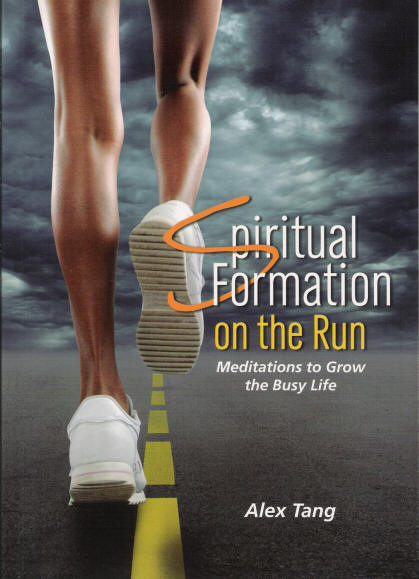
Just do it (spiritual formation on the run)

Busy - busy - super busy. More than busy - also stressed ... so re-centering time! This is a chapter in which my ramblings are long overdue ... :-)


JUST DO IT
Chapter 28 of Alex Tang's Spiritual Formation on the Run

First the chapter, then my ramblings ...

I have always been fascinated by the Desert Fathers and Mothers
who lived in the fourth century. These men and women left behind everything they had to live in the hostile deserts of Egypt, and later Syria and Palestine. The desert is a deadly, unforgiving environment. In the day, the sun bakes the land mercilessly while the nights are freezing cold. Yet these people left behind comfortable, secure lives and loved ones to live alone in the desert. They moved there to fight the demons in the desert, and the demons within themselves. Like Jesus' temptation in the desert, these elders sought the purifying furnace of the desert to encounter God. Though we are separated by 1500 years, cultural, social and linguistic differences, the teachings and sayings of these elders have much to teach us.


A brother said to Abba Poemen, "If I give my brother a little bread or something else, what happens when the demons spoil these gifts by telling me that it was only done in order to please people?" The old man said to him, "Even if it is done to please people, we are still obliged to offer what we can." He told the following parable.


"Two farmers lived in the same town. One of them sowed and reaped only a small and poor crop, while the other did not even take the trouble to sow and, as a result, reaped absolutely nothing. If a famine comes upon them, which of the two will find something to live on?" The brother replied, "The one who reaped the small poor crop:' The old man said to him, "So it is with us: we sow a little poor grain, so that we will not die of hunger."


Abba Poemen has given us two important lessons on serving or ministry. First is that no matter what we do, it will always come out of impure motives because of our fallen nature. There is no such thing as pure altruism. Everything we do will be tainted by our sinful nature. Somehow, pride and a desire for power, glory and affirmation will dog our every action. Does this mean we do not do anything? Abba Poemen said even if our motives are impure, we still need to serve others. This reminds me of the disciples who complained to Jesus that some people were baptising people in His Name. Jesus' answer is illuminating - so what, they are also doing God's work! (paraphrased Mark 9:38-39)


The second lesson is that we have to sow even if the harvest will be meagre. In the parable, Abba Poemen did not elaborate on the soil condition in the town. The soil must have been so infertile that the second farmer did not even bother to sow. Yet the elder said, "So it is with us: we sow a little poor grain, so that we will not die of hunger." There are times when our service seems to fall on such hard ground. For all that we put into our labours, the outcome is so discouraging. We became frustrated because we do not see the fruit of our labour. Those whom we serve do not appreciate us. Our loved ones misunderstand our calling. We burn ourselves out in an effort to generate "results." As we look at our own service or ministry situations, we maybe tempted to give up like the second farmer. Jeremiah, often known as the "weeping prophet;' never did see the fruit of his labour. In spite of his preaching, his people refused to repent and he saw the destruction of his beloved country. Yet Jeremiah persisted until the end. Explorer and missionary Dr David Livingstone made one convert in all his years of hard work in darkest Africa. Yet his explorations opened the way for others to follow, and the years after his death saw the opening of Africa to see the Light.


Abba Poemen's message is simple: Just serve the Lord as faithfully as you can. Sometimes we can be so hung up on the whys and wherefores that we lose sight of our calling. We are called to be faithful servants.

-----

WARNING! The following ramblings meanders even more than usual ...

I think one of the problems I have (that many will identify with) is that it is hard for me to say NO. I tend to say YES quite readily, and then much farther down the road (from hindsight) I wonder if it would have been wiser to have said NO.

What's good is that I have generally figured out the areas where I will almost always say YES to. So at least since I know, I can be more aware - theoretically that is. But maddeningly this is not necessarily the case! Perhaps it is not the wisest thing to do to share what they are! LOL But perhaps just two as some elaboration is needed for this post to make sense.... The first is opportunities that will open doors for kingdom related work. And the second is when good friends ask for help. So now you know two, so please don't abuse this knowledge! :-) The trouble is of course that even those two general areas cover a vast variety of situations and really, it is hard to say NO in these two areas.

An additional problem I have with saying YES is that the more I do, the harder I work and more involved I become, the more the chances of becoming over worked, stressed out, distracted and / or misunderstood. Yes, even in what would seem clearly to be doing positive things and God's work. My list of "good things" I have done and am doing (or trying to do) that is causing me stress gets longer each year. :-(

My problem is compounded further in that it is frustrating for me that often for all my best intentions, there are some situations where my motives are questioned (rather unfairly). Just makes me want to give up. Sound advice that many will give is to ignore your critics ... Easier said than done as my God given temperament is such that I have a tendency to OVER-REFLECT. criticisms stay in my system for a long time. What is good is that if properly considered, analysed and prayed over, there will always be opportunities for improvement and spiritual growth. What is bad is ... hmmm do i even need to spell this out? :-)

I would have preferred a chapter titled. JUST DON'T DO IT! A chapter that will give me more reasons to pack up my bags and join a monastery or something like that! Problem is, of course, joining a monastery will present a different set of challenges where the basic issues of life will present themselves in a new form.

I have a love hate relationship with the phrase "JUST DO IT". :-) Not because I have anything against Nike, but it reminds me of the title of one of my own sermons that will not let me go - a sermon on the Good Samaritan. And of course after months of abiding this chapter, it keeps coming back to my mind (oh foolish me to keep a file on this topic on my desktop as a reminder that it is a project that is still pending :-)) Then of course I had to preach a sermon last week on The Lost Sheep and Lost Coin (Luke 15:1-10) ... and guess what my next sermon is on? The Prodigal Son *sigh* :-)

Okay, what has helped me. First is that no matter what we do, it will always come out of impure motives because of our fallen nature. Somehow, pride and a desire for power, glory and affirmation will dog our every action.

That is liberating (though it sounds strange) - and I am currently listening (and re-listening) in my car the Pastor to Pastor CDs on Personal Holiness.... (oh the irony). I struggle so much with the reasons why I serve. Why I say YES. I want my service, my relationships to be pure and unconditional. Yet I don't want to fall into the trap of substituting works and service for grace. It is liberating because I think I finally get it (hope there is no relapse! :-)).

It's okay to want to set an example for others. It's not necessarily pride - though a bit of pride is in a way involved.

It's okay to blog about my life and joys and successes, and to preach using positive personal lessons I am learning .Yes, there is the danger of becoming puffed up but it is also truth in real life. It's okay for me to be tired and discouraged and even a bit grumpy (occasionally). It's part of being a flawed human, and it's okay as long as I also repent and learn and grow to be a better person in Christ.

It's okay for me to grab hold of the many opportunities that have the potential to further the kingdom of God. Yes, even positions that put me into positions of greater authority than I am fully comfortable with. It is a good thing to be willing to serve in such positions when one enters with a deep awareness and fear the temptation of power and glory.


The second lesson is that we have to sow even if the harvest will be meagre.

It can be discouraging to plod on and not receive encouragement. It is worse when the silence is only broken by criticism and negativity. But the harvest imagery is so precious. Galatians 6:9-10 has been in my mind a lot the last few years. Let us not become weary in doing good, for at the proper time we will reap a harvest if we do not give up. Therefore, as we have opportunity, let us do good to all people, especially to those who belong to the family of believers.

BTW, there is a connection between Galatians 6:9-10 and the areas in which I tend to say YES ...

After nearly 20 years in full time vocational ministry, I look back and see many failed projects, but just as many successful ones. Not necessarily successful in terms of the original goals but definitely successful in terms of relationships built. These may have been by products but I see these now as the most significant.
I need to keep this in mind in the many current projects / activities I have said YES to. I need to remember my calling and focus is built around Christ and to be people oriented.

Abba Poemen's message is simple: Just serve the Lord as faithfully as you can. Sometimes we can be so hung up on the whys and wherefores that we lose sight of our calling. We are called to be faithful servants.


Other Paul's reflections


Keep in Step
Why the Hulk should be red not green
How expensive is your church?
How heavy is your burden?
Shout to the world
The silence in the noise
Omission and Commission
A Burning Bush

Labels: , , ,

Saturday, April 24, 2010

Thomas Merton on Distractions


Suppose that my "poverty" be a hunger for spiritual riches: suppose that by pretending to empty myself, pretending to be silent, I am really trying to conjole God into enriching me with some experience - what then?

Then everything becomes a distraction. All created things interfere with my quest for some special experience. I must shut them out, or they will tear me apart. What is worst - I, myself am distraction. But, unhappiest of all - if my prayer is centered in myself, if it seeks only an enrichment of my own self, my prayer will be my greatest potential distraction. Full of my own curiosity, I have eaten of the tree of Knowledge and torn myself away from myself and God.

I am left rich and alone and nothing can assuage my hunger: everything I touch turns into distraction.


Thomas Merton
Thoughts in Solitude, 93

Labels: , ,

Wednesday, March 17, 2010

Book Review on Alan Jones' Soul Making


Alan Jones (1985) Soul Making: The Desert Way of Spirituality (San Francisco: HarperSan Franciso). The Very Reverend Alan Jones has been the Dean of Grace Cathedral (Episcopal) in San Francisco (1985 -2009). Previously, he served as the Stephen F. Bayne Professor of Ascetical Theology at the General Theological Seminary in New York City from 1972 - 1982. During his tenure, he founded and was the first director of the Center for Christian Spirituality at General Theological Seminary .

I often confuse Alan Jones with Tony Jones. Tony Jones is with the emerging church movement and is theologian-in-residence at Solomon Porch in Minneapolis.

LOOK, WEEP, LIVE is how Jones summaries the Desert spirituality. Looking is seeing beyond the superficiality and delusions of our lives. Weeping is the "gifts of tears" of the desert fathers and mothers. It is the tears from the breaking down of our illusions and becoming aware of our sinfulness and brokenness. Living in desert spirituality is to live a life for God, free of attachment to the material things of the world, focusing on what is eternal and holy. Jones describes certain aspects of desert spirituality very well, showing a wide scope and depth of knowledge in other traditions when he draws upon their koan and stories to illustrate certain points.

What impresses is when Jones compares and likens desert spirituality to psychoanalysis. There may be commonality between the two approaches but whether desert spirituality may be reduced to the agnostic approach of psychoanalysis is questionable. The commonality of desert spirituality and psychoanalysis according to Jones are:

(1) The need for detachment.
(2) The belief that nothing is accidental.
(3) The fact that we are not as free as we think we are.
(4) The conviction that remembering is an important part of growth.
(5) The belief that while we have to do much of what we do alone, companionship is essential.
(6) The necessity of contemplative commitment.
(7) An appreciation of our 'fallenness.'
(8) The mystery of having to let go of the things and people we love the most. (p.48)


Jones posites correctly that love is the foundational emotion or force in desert spirituality and whether to love or not is a choice. "The desert believer chooses Jesus and is chosen by him," states Jones, "And this choosing becomes a way of knowing, loving, and living that knows no end. Soul making is a matter of choosing the reality of love by which all other realities are tested as if by fire." (p.209).

This is an excellent book on desert spirituality, one of the most challenging among the many forms of Christian spiritualites. It is worthwhile to buy and read, and reread for the many gems buried in the desert sand.

.

Labels: , , ,

Friday, January 08, 2010

Brian McLaren's Losing Faith


This video is an interesting way to promote his new book "Losing Faith." However it contains many controversial statements. I cannot wait to read the new book to see how Brian explains them.

He writes,
i think we all go through a process of leaving childish things behind ... and embracing a bigger picture as we grow and mature. this is a central theme of my upcoming book, "a new kind of christianity: ten questions that are transforming the faith," which will be released February 9, 2010.


Labels: , , ,

Saturday, January 02, 2010

The Complete Mystical Works of Meister Eckhart


The Complete Mystical Works of Meister Eckhart (2009). M.O'C.Walshe (trans) New York: The Crossroad Publishing Company.

This book is actually a reissue of the three volume Meistert Eckhart: Sermons and Treatises, translated and edited by M. O'C Walshe. These three volumes were published in 1979. Meister Eckhart is my favourite Christian mystical writer and philosopher. M. O'C Walshe did a good job in translating his sermons and writings. Eckhart presents his scholarly and academic writings in Latin while he preaches and presents his reflections in the vernicular German. The German portion of his works are often referred to as his mystical writings.

in the midst of silence, there was spoken within me a secret word...But where is the silence and where is the place where the word is spoken?...It is in the purist place that the soul is capable of, in the noblest part, the ground...
.

Labels: ,

Wednesday, November 04, 2009

St Kevin and the Blackbird

This is a remarkable comment by Liz Budd Ellmann of Spiritual Director International, published in the newsletter Membership Moments November 2009

For more than a thousand years, pilgrims have visited Glendalough where Saint Kevin played, prayed, and discovered his purpose. One day, the legend tells us, while Kevin the monk was praying with outstretched arms, a blackbird landed in his hand and built her nest. Imagine holding a prayer stance -- in Zen stillness -- long enough for a blackbird to build a nest and raise her young. The Irish poet Seamus Heaney beautifully teaches us about the spiritual companionship between the blackbird and Saint Kevin,

And then there was St Kevin and the blackbird,
The saint is kneeling, arms stretched out, inside
His cell, but the cell is narrow, so
One turned-up palm is out the window, stiff
As a crossbeam, when a blackbird lands
And lays in it and settles down to nest.
Kevin feels the warm eggs, the small breast, the
tucked

Neat head and claws and, finding himself linked
Into the network of eternal life,
Is moved to pity; now he must hold his hand
Like a branch out in the sun and rain for weeks
Until the young are hatched and fledged and flown.

And since the whole thing's imagined anyhow,
Imagine being Kevin. Which is he?
Self-forgetful or in agony all the time
From the neck on out down through his
hurting forearms?

Are his fingers sleeping? Does he still feel his knees?
Or has the shut-eyed blank of underearth
Crept up through him? Is there distance in his head?
Alone and mirrored clear in love's deep river,
"To labour and not to seek reward," he prays,
A prayer his body makes entirely
For he has forgotten self, forgotten bird,
And on the riverbank forgotten the river's name.

Saint Kevin’s whole body became a prayer of love that recognized God in an ordinary blackbird. Now imagine me, standing across the lake from Saint Kevin’s cave. Gazing into the lake, I contemplated the blackbird resting in Kevin’s hand and the call for contemplative action in today’s world to become responsible stewards of all God’s creation. Suddenly, my soul felt seen by Saint Kevin, staring out from his cave. In that instance, a robin started singing from a branch just over my head. In that thin place, I felt Saint Kevin’s love encouraging the kind of singing presence that sees God in all things.

Labels: ,

Thursday, October 15, 2009

Miracles in the Middle Ages


In the period between 1150 and 1550 a number of Christians in western Europe made pilgrimages to places where material objects--among them paintings, statues, relics, and Eucharistic wafers--allegedly erupted into life by such activities as bleeding, weeping, and walking about. In this lecture, Professor Bynum describes the miracles, discusses the problems they presented for both church authorities and the ordinary faithful, and probes the basic assumptions about matter that lay behind them.

Labels: , ,