Monday, August 11, 2014

The Digital Doctor


During one clinic session, I look down at my desk and could not see it! It was covered by keyboards, mouse, tablets, smart phones, and all other electronic connection that a doctor needs today. I have my medical notes in my website in a server hosted in USA, my paediatrics notes at UpToDate somewhere else at their company server farm, my half written books and writing projects in Dropbox, my students files in Google Drive, my literature search via Monash virtual library hosted in Australia, my access to Monash online courses in Moodle in Kuala Lumpur, and my patients’ file in a cloud somewhere between Johor Baru and Kuala Lumpur. My Facebook, Linked-in, Google+, Tumbr, Twitter, and Pinterest accounts are in another cloud somewhere around the world. Oh yes, my online gaming Star Trek Online and TitanFall.

Technology has both hindered and helped me. I spent 50% less time talking to my patients and their parents as I used these of their 50% clinic face-to-face time with me to key in their online electronic prescription on the computer on my desk. In the past I was always able to give them my full attention as I sit facing them as I write out my prescription on paper. Now I have to turn away from them 90 degrees to face my computer. It is hard to carry on a conversation when you are facing the screen and trying to type in important information and to double check its accuracy. Believe me, I have tried. I am not that good a multitasker. Patients and their parents are aware of this. After a while there is this awkward silence as I key in their prescriptions.


Another subtle influence I have to consciously resist is that by keying in information and prescription, I am forced to think of my patient as an object. This object is defined by data and numbers. My patients have always been and will be persons to me. I did not sign up to be a doctor so that I can reduce them to data. This aspect of modern medicine is worrisome to me.

.

Labels: , , ,

Monday, August 22, 2011

English as I Speakee It

Overseas readers of this blog and my corresponding website often scratch their heads in puzzlement at my English or rather the way I use it.

Peggy Tan highlights the way Malaysians speakee English

Asking someone to make way
Britons: Excuse me, I’d like to get by. Would you please make way for me?
Malaysians: S-kews / squeeze me, please.
Asking someone to find out what had happened
Britons: Will someone please tell me what has just happened?
Malaysians: What happenleh? Why like that one?
When asking for permission
Britons: Excuse me, but do you think it would be possible for me to enter through this door?
Malaysians: (pointing at the door) Can enter ah?
When assessing a difficult situation
Britons: Hmmm. We appear to be in a bit of a predicament at the moment.
Malaysians: Ayoh! Die-lah! Mati loh?
When declining an offer
Britons: If you don’t mind, I’d prefer not to do that.
Malaysians: I don’t want lah.
In disagreeing on a topic of discussion
Britons: If you don’t mind, Timothy, I do have to interrupt, and I must say I have to disagree with you about this issue.
Malaysians: What stupid idea! You mad and crazy ah?
When asking somebody if he/she knows you
Britons: Excuse me, but you seem to be staring at me. Have we met before?
Malaysians: Why you look at me like that? See what?
When someone is angry
Britons: Would you mind not shouting at me?
Malaysians: Cilakak! You no manners or what man!

read the rest of the article here

.

Labels: ,

Wednesday, April 20, 2011

Learning the Presentation Skills of Steve Jobs


and you can find some greats videos of Steve Jobs' presentation here

Labels:

Thursday, October 07, 2010

Good Story Telling


Something about story telling and community from the conference Catalyst from Learnings@Leadership Network

Jon began by posing the question, "Why don't we use our best creativity to celebrate the Creator?" In his talk, he outlined seven things that a good story needs in order to create community. Here's a brief rundown:
  1. SPACE - every story needs space to let others tell their story within it. Give your audience a chance to step into your story and fill in the gaps.
  2. BRIDGES - every story has a hook and a core message. A good story keeps those close together (bad stories have a disconnect between the two).
  3. SURPRISE - we are an overcommunicated society, so you need to break through the clutter by being surprising, otherwise your brain will file something away as, "oh, I know what this is..."
  4. HONESTY - in a world where we are obsessed with talent, people are looking for honesty. It's really easy to find talent on the Internet. Honesty is scary, and it's our job as Christians to go first.
  5. PATIENCE - a following doesn't happen overnight. Instead of asking, "How can I get more readers/followers?" ask "How can I give more of me to more of them? How can I lead generously?"
  6. COMPASSION - Jon uses humor in his writing, but he said there's a fine line between mockery and satire. Satire has a purpose. Seed conversation for ideas - but don't chum the water for sharks.
  7. MEANING - if you don't have something that matters, people won't stick aroudn to build community. Something can be viral, but that's not the same - to change the world, you have to be bigger than yourself.

read more

picture source

Labels: ,

Sunday, August 08, 2010

Book Review on Qualman's Socialnomics


Erik Qualman (2009), Socialnomics: How Social Media Transforms the Way We Live and Do Business, Hoboken, New Jersey: John Wiley & Sons, Inc

Erik Qualman is Global Vice President of Online Marketing for EF Education with extensive experience in e-marketing, e-business, search engines, and maximising the impact of the social media. Social media includes social networking sites such as Facebook and Myspace, twittering, blogs and the internet. Qualman wakens the world to a new reality. As he writes, "the world as it was, no longer is"(p.14). This cryptic remark is the key construct of his book as he tries to show how social media has changed the way people connects, communicates, interacts, and changes their perception of reality.

Qualman confirms what most of us are aware-that social media is changing the very fabric of our society. His chapter on how Obama became president is illuminative. The data mining of people's use of search engine may predict future social trends is interesting. The little known fact that Pepsi, by using Yahoo's search engine data, was able to predict Britney Spears' popularity a few months in advance and are able to sign her up for their commercial is telling. Unfortunately this did not able to save her from the dangers of becoming a celebrity.

Social media especially micro-blogging such as twitter and texting, argues Qualman, actually makes people better because whatever they have sent into the internet will remains as a permanent record. While the records are permanent, it is debatable whether most people actually care about that-except maybe politicians and CEOs. People will continue to spin a more than perfect image of themselves online.

It is hard to prove that the economic influence of the social media is as powerful as Qualman suggests. People who are active in social media, called soialmedioraties, still remains a small segment of the demography which may not be identical to the demography that has the purchasing power. Nevertheless, it is worthwhile studying the trend especially since Facebook membership has reached half a million people. Still only a small fraction of this many people are active. Most will have an account with which they access for an occasional update.

In a people-driven economy, social media has potential for an increasing role. However as most of the people of less developed countries do not have internet access to this social media, one does wonders how this will translate to the rest of the world.

.

Labels: , , , , ,

Tuesday, August 03, 2010

Wales and the Founding of Wikipedia


Jimmy Wales: Founder of Wikipedia

With a vision for a free online encyclopedia, Wales assembled legions of volunteer contributors, gave them tools for collaborating, and created the self-organizing, self-correcting, ever-expanding, multilingual encyclopedia of the future.

Jimmy Wales went from betting on interest rates and foreign-currency fluctuations (as an option trader) to betting on the willingness of people to share their knowledge. That's how Wikipedia, imagined in 2001, became one of the most-referenced, most-used repositories of knowledge on the planet, with more than one million articles in English (compared with the Britannica's 80,000) and hundreds of thousands in dozens of other languages, all freely available.

The "wiki" in the name refers to software that allows anyone with Internet access to add, delete or edit entries. This has led to controversies about the reliability of the information, prompting the Wikimedia Foundation to set tighter rules for editors, while still keeping Wikipedia open-source. One thing is certain: Wikipedia will never be finished. In the meantime Wales has started working on Wikiasari, a wiki-style search engine.

"Wikipedia represents a belief in the supremacy of reason and the goodness of others. ... From the respectful clash of opposing viewpoints and the combined wisdom of the many, something resembling the truth will emerge. Most of the time."
WIRED

Labels: , , , ,

Tuesday, July 27, 2010

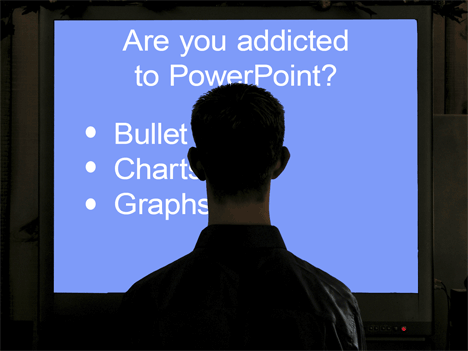
Does Powerpoint have Power? A Response


My dear friend Rev Dr Tan Soo Inn recently asked this question in his weekly GRACEWORKSMAIL 29/10. Please read the whole ecommentary here. He mentions that he does not use powerpoint in his presentations but uses handouts. In support of his not using powerpoint, he mentions two heavy weights like Christopher Witt and John P. Kotter who allegedly do not use powerpoint and have their reasons for not doing so.

According to Witt, powerpoint is good in conveying information not in persuading, hog the audience's attention and takes time preparing. All these three reasons are true. But is that a strong enough defense against powerpoint usage? Preaching and teaching are forms of communication. In any form of communication, there must be some information exchange. Communication must engage the audience and the speaker's face (no matter how handsome) should not be limited to as the only area of focus, and while it is true that power point take time to prepare, it seems to me strange to be given as a reason against using it. In preparing a sermon or a talk, if we begrudge the amount of time preparing powerpoint compared to research and data collection, then we have missed the whole point of the process of successful communication.

Saying that, I agree with Soo Inn that it is the messenger, not the powerpoint. I will also hasten to add that it is also the message and the audience. Personally I do not differentiate Christian preaching and teaching into two categories. To me, all Christian preaching and teaching are evangelistic and for edification. There can be no separation between the two. It is the work of the communicator to distill the huge amount of raw data from his/her research to the core of the message to be delivered. Personally I have to rework all my sermons or teachings 3-4 times to par down the amount of information to the core or essential sermon or teaching statement I want to convey. Who I am, my communication skills and my powerpoint are the means to convey this core or essential statement.

As communicators, we need to study our audience. Gone are the days when they are able to sit through hours of sermons or lectures. It may still work with the older folks but the younger folks have a different way of communication, hence the new social media. In a post modern audience used to two seconds sound bites, visual and musical ques and multimedia presentations, instant response and feedback (via texting, twitter, MMS, mobile video), the challenge is for communicators to connect with them in an effective manner.

Thank you for this stimulating ecommentary. An addendum: as we learn homiletics to communicate, communicators especially Christian pastors must learn how to design appropriate and effective powerpoint slides!

picture source

Labels: , ,

Monday, July 12, 2010

Facebook as a Learning Management Tool

Technology is changing education. William Drummond explores using Facebook as a learning management tool and a panel explores the 21st century student. [12/2008]

Labels: , , ,

Tuesday, June 22, 2010

The Digital Great Commission

In my article The Influence of Globalisation on Christian Spiritual Formation in Churches In Malaysia and Singapore I highlight the use of technology may be missional.

Globalisation is not necessary bad. Using the improved communication and extensive networking provided by new technologies, it is easier to proclaim the Gospel to the whole world than before. The Internet has made it possible to reach even the remotest part of any country as long as there is Internet access. It has also allowed even the remotest part of the world with Internet access to be readily accessible. A Christian website may be accessed by anyone, even those in areas not accessible to missionaries. Social networking allows people to connect over long distances which otherwise will not know of one other’s existence. Streaming videos and MP3 allow download of materials anywhere in the world. The global culture has a made inroads into many other cultures. It is a two-way street. Local cultures may influence global culture. There is much potential in the wise use of art, music, video and writings to spread the Gospel. Anyone can upload something onto the Internet and have it viewed by thousands within the hour! YouTube may be used as a media for evangelisation. Virtual Christian faith communities may be set up online. The degree of Christian spiritual formation that may be done through the Internet has not been fully explored.

Christianity Today runs a Global Conversation on technology and mission.

Top Story
THE GLOBAL CONVERSATION
The Face-to-Face Gospel and the Death of Distance
Al Erisman says we need to think about ministry in the digital culture the way missionaries think about the culture of the people they serve.


RESPONSES:
Nigel M. de S. Cameron: Sci-Fi Reality
Wha-Chul Son: Technological Divide
Juan D. Rogers: Not Just Tools
Haron Wachira: Blessings & Curses of Technology

Video: Emotional Robots


.

Labels: , , , ,

Wednesday, February 24, 2010

Will You Be My Facebook Friend?


Do you get irritated by people who invites you to be his or her friend on Facebook? Or are you happy to be invited. What if you decline? Are you worried about offending someone? Richard Baum of Reuters writes about How to decline Facebook friends without offence. He offers some suggestions

One is to accept the invitation and then use Facebook's privacy settings to limit the flow of information between you and your new "friend." To do this, you can create a "colleagues" list from the Friends menu and then add to it your new friend. Then navigate to the privacy settings and use the "Profile Information" section to control what information people on the "colleagues" list can see.

An alternative, says workplace etiquette expert Barbara Pachter, is to suggest to the colleague that you connect instead on LinkedIn, a social network for professional relationships.

"You can just go ahead and ask them to join you on LinkedIn and hope they forget they sent you a Facebook friend request," said Pachter, the author of New Rules @ Work.

"Or you can say, Thanks for asking me. I'm keeping Facebook for my family and friends. I'm asking you to join me on my professional network instead.'"

Pachter said that whatever you do, it's important not to offend your colleague -- and that's not just because politeness is good etiquette.

"The person you offend might end up being your boss next year," she said.

Ha. That's unlikely for me but I do like to make friends on Facebook. Each friend brings new aspects and perspective of humanity. For a student of human nature like me, that is a bonus. Some reveal too much of themselves while others reveal too little. Yet each life is of value and I am constantly being amazed at the diversity of my friends' interests. I am also amazed at how much time some of my friends spend online with Facebook. I assume they do have a life somewhere.

It is interesting that Facebook was started only 4 years ago according to Wiki but 6 years ago according to founder Mark Zuckerberg in his Facebook blog. This is because Facebook seems to be around like forever. Entertainment Weekly notes its value, "How on earth did we stalk our exes, remember our co-workers' birthdays, bug our friends, and play a rousing game of Scrabulous before Facebook?" This was also during the peak of blogging. Nowadays, many bloggers are Facebookers (yes, there is such a term. I checked).

Many Facebookers are also gamers. The top 5 games on Facebook today are Farmville, Mafia Wars, Cafe World, Fishville and Zunga Poker. CNN Doug Gross gives us the highs and lows of The Facebook games millions love (or hate). No, I have not played any of these games yet. I am still trying to figure out Star Trek online.

Facebook is a virtual watering hole for the gathering of the futurists, the nerds, the internet addicts,the technocrats, the lonely, the bored, the seekers, the gurus, the joyful and the sad. Facebook is a pub in L-space. It is also a place of interconnectivity for people to connect with one another, keep abreast of each others' activities, and retain a sense of control in our fast moving fragmented world. It is also a safe place to hide from intimacy and the emotional investments of a 'real' human relationships. As in the television series Cheers, it is a place where everyone knows your name!


Update

After writing this post, I read a blog post on Facebook Friendship by my Facebook friend Bob.

picture credit

Labels: , ,

Friday, September 18, 2009

Communicating with iGens

From Leadershipjournal.net

This Week in Leadership EVANGELISM
The Gospel for iGens
Reared on self-esteem and impervious to guilt, the next generation needs good news that can break through their defenses.


The first step a young man takes toward a woman who he thinks might be his future is delicate. The operative words seem to be "sensitive" and "careful" and "first impressions matter." As in love, so in "gospeling" (or evangelism). When Peter preached at Pentecost, he opened his sermon with a time-honored citation of Scripture and then sketched, in third person, what had happened to Jesus.

| Finish this article |


also check out the new digital magazine from Leadershipjournal.net; a journal which is multimedia; has text and video articles.


Catalyst LeadershipCatalyst Leadership

See the August/September edition of Catalyst Leadership

Labels: ,

Saturday, July 25, 2009

Top Kingdom Ideas

from Learnings@Leadership Network,

Warren Bird, Ph.D., is Research Director at Leadership Network, and co-author of 21 books on various aspects of church health and innovation writes


Participants at this week's Leadership Network-sponsored Ideation Experience began their 48 hours together by developing a "top 10" list of top kingdom ideas over the last decade. The original poll to help determine the list of nominees can be found here.

The winning ideas were . . .

• Externally focused churches as key idea for evangelical churches
• Shifting opinions on social issues in the 18-35 year old demographic that are shaping the emphases of the church
• Multi-site churches
• The rise of networks as the key focus for church planting and resourcing in other ways
• Open source content freely given away for church resources via computer
• The rise of church websites/pastor blogs/podcasts and videocasts as church communication tools
• Social networking tools (facebook/twitter/myspace/custom tools) being utilized by churches and parachurch groups
• Bringing management and leadership focus into church in a fresh way
• Greater awareness by U.S. megachurches and others to international missions and humanitarian efforts around the world
• From “marketplace to ministry” as strong source of staff members of churches. Emphasis on “homegrown”
• Deeper penetration and shifts in small group models (life groups, cells, etc.) into a broad variety of churches


read more


Labels: , , , ,

Friday, April 03, 2009

The City as Educator


Cities, Youth, and Technology:Toward a Pedagogy of Autonomy
Robert McClintock
Institute for Learning Technologies
Teachers College, Columbia University
A Contribution to the International Symposium
Zukunft der Jugend
ORF RadioKulturhaus
Vienna, September 20, 2000


This is an excellent insightful lecture about youth, the new media and the role of cities. I really enjoyed it.


With the new media, in school and outside of it, we are putting very powerful tools of inquiry and communication into the hands of students. This action may change significantly the educational ecology prevailing within the city. Reforms, which did not work under prior conditions, may now flourish under emerging conditions. The limitations that undercut the progressive solution to the educational weakness of city life may be quickly overcome. The new media transfer a great deal of educational control to the student. The new media amplify the power of communication and interaction that each young person can employ. A pedagogy of open ended inquiry, which once would inexorably end in frustration and mystification, can now dependably lead to a deep, expansive engagement with powerful ideas and concepts. The exercise of choice, so characteristic of urban life throughout all ages, becomes the driving means of educational work in a well-wired classroom. The power to communicate ideas and accomplishments, essential in the urban effort to create a persona, becomes feasible for anyone who has learned to use the Internet as a locus of self-expression.

The city, extended and universalized with new media, may become the locus where all persons at all places and all times can pursue an intellectually rigorous progressive education. When that happens, the city as educator will be perfected and complete.


read more

picture source

Labels: , , , ,

Wednesday, March 11, 2009

Film Review on Fireproof


I am normally quite sceptical of "Christian movies" because they are usually quite predictable and you sort of know the ending which is usually happy or as expected.

Fireproof is about two persons in a marriage. The marriage is on the rocks and they are about to get a divorce. The husband, Captain Caleb is a fire fighter and lives by the code that "never leave your partner behind." The wife is Catherine, a hospital administrator who is tempted to commit adultery. Caleb's father challenges his son to commit to a forty day test called "The Love Dare."

This movie is a good reminder that commitment to the Lord, who is the third person in a marriage is an effective way to "fireproof" a marriage.

Labels: , , ,

Tuesday, March 10, 2009

Blogs: A Window to Our Souls

Top Story

Blogs: A Window to Our Souls
What does your Internet personality say about you?


Huh! Just hope it is not a Microsoft window.

Labels: , , ,

Friday, March 06, 2009

Facebook for Pastors

Chris Forbes of Ministry Marketing Coach has written a digital text called Facebook for Pastors which is available for free download.
image


and watch this video (not related)

Labels: , , ,

Tuesday, December 23, 2008

Why Pastors should Participate in Facebook


Pastors should participate in Facebook and other social network spaces because:

* it forces them to become more computer and Internet savvy. Many pastors are generations behind in their understanding and use of communication technology
* it introduces them to a new way of social interacting- the digital way.
* it makes them human. Depending on their openness and integrity, pastors who presents themselves as themselves will have to reveal a more personal and human side of themselves.
* allows them to understand and know what the younger generations in his/her congregation is doing in these social network spaces
* develop new aspects of their ministries. Most pastors do not realise that their ministry is limited to the verbal and printed words. They need to be missional with digital words
* provide the presence of Christ in these social network spaces
* make 'friends' with people from all over the world
* they need to create Christian faith communities in these social network spaces
* they should have fun


Read more here

Labels: , , ,

Sunday, December 07, 2008

Facing Shame in Small Groups

from smallgroup.com

Facing Shame Issues in a Small Group
Why some group members don't want to open up, and how to help
Mark Bonham posted 11/17/2008

How people's shame is responded to by a group and its leaders will determine how deep they or others will feel safe to go. What would make it safe to share issues of shame in the first place? Group leaders set the tone. When leadersare in touch with their own brokenness and can talk openly about it because they have received help and healing, they create space for others to do the same. If people are not bringing up realstruggles of the heart, could it bethat they do not feel safe because it has not been modeled in the group?

We have been talking about shame over who I feel I am. But there is also legitimate shame over what I know I've done. It is not the goal of the group to talk people out of either kind of shame. Both expose what I am allowing to define me. In both cases, I have lost awareness of who I really am in Christ. Fortunately, once I have identified what is going on, I have the opportunity to go to the Cross and confess what I have believed. It is a beautiful thing when a group can go there together with one of their members, pour out their heart in confession, and, in exchange, have the righteousness of Christ poured out on them.

read more

This is especially relevent in Asia where we live in a culture of shame.
.

Labels: , , ,

Thursday, November 06, 2008

Texting SMS

Home > Church Leaders > Current Trends & Columns > Trendex

Text Appeal

How churches are integrating new communication tools into ministry.
posted 10/31/2008 02:04PM

If you haven't heard, e-mail is so 2006. Text messages sent via cell phones are quickly becoming the communication method of choice, especially among young adults. And churches are now finding ways to integrate the medium into their ministries.

Earlier this year, Mark Driscoll, pastor of Mars Hill Church in Seattle, fielded churchgoers' questions sent through text messages during his "Religion Saves" sermon series. The approach offered anonymity (no one had to go up to an open mic) and broader participation (off-site viewers, including those watching streamed video online from home, could send in questions).
The ability to interact with the preaching via text messaging during the sermon was so well received that Mars Hill is planning to expand its use.


read more

How often do you communicate by sms in your ministries?

.

Labels: , ,

Sunday, October 26, 2008

Guy Kawasaki on Public Speaking


In his chapter on How to Get a Standing Ovation,

Guy gives the following pointers:

  • *Have something interesting to say
  • *Remove the sales pitch
  • *Customize
  • *Focus on entertaining
  • *Overdress
  • *Don't denigrate the competition
  • *Tell stories
  • *Precirculate with the audience
  • *speak at the start of an event
  • *ask for a small room
  • *pratice and speak all the time


Example of a good presentation, watch Majora Carter's here

Labels: ,