Saturday, January 17, 2015

Book Review: Face to Face

face2face

Face to Face: Meeting God in the Quite Places 
Monte Kline (2010) [Kindle edition]

 Kline's main thesis is the importance of meeting God "face to face" through Personal Retreat [capitalise 'P' for personal, author's]. The concept of personal retreats as a part of spiritual growth is well known. Kline expends on this concept of Personal Retreat by giving his definition, motivation, biblical examples, types of prayer, fasting, and specific ways to do it.

 This is a good book for those who wants to take 'time out' for a personal retreat but do not know how. What is powerful about this book is in Chapter 10 where Kline shared one of his own Personal Retreat at Steens Mountain in south-eastern Oregon in 2003. It was a humbling personal sharing about the circumstances that led him there and extracts from his personal journal on his meeting "face to face" experiences with God. Reading that allows the reader an insight on how powerful a Personal Retreat can be.

 Disclosure: I received a request to review this book by email and the kindle version.

 .

Labels: ,

Wednesday, January 15, 2014

Spiritual Formation in Theological Institutions

This is a useful book to read


Balzer, Cary and Reed, Rod. 2012. Building a Culture of Faith. Texas, TX: Abilene Christian University Press

.

Labels: , ,

Tuesday, April 24, 2012

John's Review of Tales from the Monastery

A review of my book by John (11 years old)


A Funny Book I Read


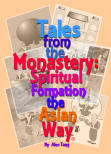
Title: Tales From Monastery; Spiritual Formation The Asian Way
Author: Alex Tang

This book is a collection of humourous stories about a group of disciples living in a monastery. The stories help us to understand God and the teachings in the Bible better.

I like ‘Ah Lek Sweeps the Floor’, ‘Durian Theology’, ‘Ah Lek Inherits Heaven and Earth’, ‘The Ban’ and ‘Walking on Water’. Rebecca and I like the same stories. They are very funny.

‘The Ban’ is very amusing because the Council  of the Abba had banned breathing and the use of soap for bathing. I like ‘Ah Lek Inherits Heaven and Earth’ because Abba Ah Beng told Ah Lek that he will never inherit God’s riches because heirs inherit what belongs to their fathers when their fathers die but God, however, lives forever.

I enjoy ‘Ah Lek Sweeps the Floor’ because when Ah Lek died, Jesus gave him a bigger broom to sweep New Jerusalem.

I learn that in certain parts of the Bible, they are not to be taken literally.

.

Labels: , ,

Saturday, December 31, 2011

Review of Lim's Life and Ministry of John Sung


Lim Ka-Tong, 2012, The Life and Ministry of John Sung, Singapore: Armour Publishing

This is a timely and much needed book in English on the biography of evangelist John Sung who played such an important part in the revivals in China and South East Asia in the 1930s and 1940s. Unfortunately, John Sung is not well known or even remembered among the contemporary churches in Asia except for a few. Among these are those who actually met Sung and whose lives were changed as a result of that meeting. Even now six decades later, these people can remember Sung clearly and with joy their remembrance of their encounter with God as a result of this meeting.

The last significant biography of John Sung was by Leslie Lyall which was written 50 years ago! Lim Ka-Tong’s biography is a distinctive improvement with more new information from Sung’s diaries and letters. Lim, presently a pastor in Texas, is a graduate of Singapore Bible College, Dallas Theological Seminary and Asbury Theological Seminary. In this book which covers Sung’s early formative years, the short 12 years of ministry and his dying years. Significantly it covers the five phases of his life; water (reimmersion, 1927-1930), door (opening, 1931-1933), dove (time to soar, 1934-1936), blood (wartime spiritual warfare, 1937-1939) and tomb (pastoral years, 1940-1944).

Lim’s book explores the impact of Sung’s ministry in the context of prewar and wartime China and South-East Asia, the Chinese worldviews and Sung’s own personal spiritual development. He does this by answering five questions:
(1)   What shaped John Sung? How did John Sung become John Sung?
(2)   In what ways did contextual elements contribute to the prominence of John Sung’s ministry and his lasting influence?
(3)   How did John Sung’s ministry contribute to the growth and indigenization of Chinese Christianity?
(4)   How did John Sung make such a great impact in so brief a time?
(5)   Why has John Sung been slighted by historical scholarship, despite his pivotal influence on Chinese Christianity?

In this book, Lim has succeeded in helping us to understand this complex and driven servant of God. He shows us the constant struggles Sung had in his spiritual life and his ‘unconditional’ surrender of everything to God. It is a hard lived life of seeking God and seeking his will in making choices. These choices including a life of comfort in the United States or poverty in China, ministerial ‘success’ or itinerary wanderings, theological conservatism (fundamentalist) or liberalism, being a ‘Chinese’ Chinese or a Western educated Chinese, and living a kataphatic or apophatic Christian spirituality. It is a result of these struggles that Sung was able to have such an impact in his ministry.

This is a highly readable and interesting book and a must for all Christians especially for those who want to appreciate the Asian and Chinese Christian heritage.

.

Labels: , , , ,

Thursday, November 10, 2011

Review of Dallas Willard's Renovation of the Heart


Blogpastor wrote an excellent review of this book over at his blog. He brought out many points which are my concerns too when I first read this book.

The approach of breaking down all the human elements that need transformation is also a very Western and scientific approach. It helps me to understand each particular part and how it functions together and deepens my understanding, but it also overwhelms the individual with too much applications, and it feels quite cumbersome. It may be better if he had taken a more Asian or holistic and biblical approach and viewed the human being as a whole and demonstrated how Christ’s death and resurrection has provided a basis for the renewal of my whole being and how the church needs to provide a conducive context where all its members can better predispose themselves to the ongoing grace of sanctification.

read more

.

Labels: , ,

Tuesday, October 25, 2011

Review of A Silent Action by Rowan Williams


What has the Archbishop of Canterbury, head of the Anglican tradition has in common with a Cistercian monk from America? There is much in common between these two men who has never met face to face. This 2011 book is a compilation of various engagements of the Anglican theologian and the writings of the religious catholic in a series of lectures and journal articles over a period of time which was written by the Archbishop. I believed that Thomas Merton will be bemused if he is aware of the interest the Archbishop has bestowed upon him.

There is much to reflect upon in this slim book which reveals the spiritualites of these two men and their journeys on the contemplative path. During their journeys, they involved and engaged many other theologians into their dialogue which includes Reformed theologian Karl Barth and Orthodox theologian Vladimir Lossky. Mostly they have interacted with each other. What stands out in the dialogue is their conviction of God as the ground of their being and their commitment to the contemplative path as the journey in the silence of the soul from the false self or what Thomas Merton refers to as the 'delusory self image' to the real self.

A good read for fans of Rowan Williams and Thomas Merton.

note: The water color of Canterbury Cathedral on the book’s cover is by Owen Merton. In The Seven Storey Mountain, Merton refers to his father painting in the Cathedral Close at Canterbury during his Easter vacation from Oakham in 1929.

Labels:

Monday, October 24, 2011

Review of The King Jesus Gospel


Prof Scot McKnight is a theologian, proliferate blogger and writer who has published several books such as The Jesus Creed (2004) and One.Life (2010) which are worth reading especially for those who are interested in spiritual formation. In this latest (2011) book, McKnight put forward the thesis that the contemporary North American Protestant churches are stuck in a 'salvation culture' mode when they should be in the 'gospel culture' mode. Being in the 'gospel culture' mode will ensure that these American Christians  become disciples of Jesus Christ.

The key to his argument is the definition of the gospel. McKnight defines the gospel as the good news of God's plan for a people of God worshiping Him in 'cosmic temple ' in Gen 2 to the 'new Jerusalem in Revelation. This includes fulfilment and completion of Israel in Jesus' coming, death and resurrection. The emphasis will then be also on Jesus as Lord and King in the kingdom of God in the post-resurrection era. He compares this to some understanding of the gospel as the good news for personal salvation. He attributes this 'salvation gospel' and its resultant 'salvation culture' to be the result of Augustine and the Reformation influences.

I find his distinction between the gospel announcement and personal salvation a little disturbing. And also the lower role of justification by faith he assigns in the gospel message. In his excellent exegesis of  1 Corinthians 15:1-5, 20-28, he tries to separate them but instead of either/or, I wonder if it should be and/plus. The gospel message aside from the  telling of the Israel and of Jesus should also include personal salvation and justification by faith. It will be useful if McKnight examines other Scriptures that explain the gospel message and share his thoughts on them.

I agree with McKnight in most parts but at times, I am left wondering at how did he arrive at his conclusions in others. It is a thought provoking book about our basic understanding of the gospel and salvation. Again as in many 'theological' discussion, I am left with a 'so what.' How does a gospel culture helps us to become committed disciples? Here, McKnight refers us back to his book One.Life. One.Life, like his Jesus Creed describes what we should do as disciples rather than how do we motivate people to intentionally become disciples. I believe that is the foundational question facing the church today. The debate about the gospel and salvation is a symptom rather than the issue. Christians know all about discipleship and following Jesus. The issue is how to get them to intentionally become one.

.

Labels: ,

Monday, August 01, 2011

The Why and Who of Suffering


This book by Adele Gonzalez attempts to answer the age old question of suffering which may also be subtitled the problem of evil. Rephrased in another way, why does a good and loving God allows His beloved people to suffer and evil to proliferate in the world? I do not believe this book adequately answer the question. She started off with a somewhat fatalistic 'shit happens' which embrace a lot of encouragement to bear with our sufferings and remember that God is good to a somewhat mystical retreat into the Mystery of God i.e. we cannot understand suffering because it is part of the Mystery of God.

Gonzalez seems to be deeply influenced by the teaching of the church father Irenaeus. Irenaeus teaches that life on earth is like school for training us for eternity. Suffering and evils are lessons that helps us to learn. Another theologian from whom she draws inspiration is Jesuit Teilhard de Chaidin (my review here and here). Appropriating de Chaidin's Cosmic Christ and Omega Point, Gonzalez skips on the edge of pantheism when she writes about 'energy from our suffering' helps to complete the suffering of the Cosmic Christ and to be one with the Cosmic Christ at the Omega Point.
The strength of Gonzalez's book is not in answering the question of suffering and of evil. I do not believe we will get the answer this side of eternity. This book is inspirational because while it fails to answer the question, it succeeds in providing a companion for our journey through this world which is full of suffering. In sharing her experiences of suffering in her life story, her problems with the institutional church and her physical disabilities, Gonzalez becomes our companion in suffering. She reminds us that we are not alone in our pain and suffering. We suffer together as a community, and as a church. Gonzalez also reminds us that the transcendent God Himself also suffers with us.

Maybe we have been asking the wrong question. Instead of why, we should be asking who. Who is suffering? Who is suffering with whom? God is suffering with whom? 

Good book for the online reading group. Onwards to the next book.

.

Labels: , ,

Thursday, June 30, 2011

Challies' The Next Story


Tim Challies, (2011), The Next Story: Life and Faith after the Digital Explosion, Grand Rapids, MI: Zondervan.

Pastor, author and blogger Tim Challies asks three important questions about technology. He deals mainly with the impressive development of the technology of the CPU, Internet and digital communication. The three questions are (1) 'if technology was somehow taking over my life', (2) 'if it was remaking me in its image', and (3) 'if it was making me a tool of my tools'. His approach to answering these three questions is systematic as he deals with the theory, theology and experience of technology in the areas of (1) communication, (2) mediation/identity, (3) distraction, (4) information, (5) truth/authority and (6) visibility/privacy. Though there is scope for a wider work, the questions by its design imply his personal experiences and reflections.
Whether we are in a post-digital explosion era or still in the digital explosion era may still be argued. The social media is still expanding and the next 'killer' apps may be just below the horizon. The digital revolution, for all its hype is still limited to a few prosperous countries while the majority of humankind is not able to read or write, least of all to use a computer.

Are we in the 'next story' is also open to debate. Technology does not change human nature, only the means for human nature to achieve their purposes. One would not call the era after the invention of the printing press which is the technology similar to the present digital revolution the 'next' story. It is still the continuation of the human story.

Challies' experience with the digital is an interesting read but is hardly representative. He was right that his book was descriptive but it contain just too much history and facts about the digital revolution. Unfortunately there are too many of such 'descriptive' books in the market. However I have enjoyed his 'prescriptive' and learned much from his suggestions for Christians in the use of the digital media. One idea that stands out his is suggestion that we become accountable for our blog postings. I have never though of that though I have accountability groups for other aspects of my life. The book will may be better if it is more prescriptive.

Challies asked three important questions that need to be considered. Will the digital technology enslave us, keep us in bondage and force us to worship idols. With respect to Neil Postman and Marshall McLuhan, I believe that human nature has not changed since the time of creation. At present, we just have more toys to play with. We have in our human nature the propensity to addiction. Digital technology offers yet another thing to be addicted to. Living in another time, those who are enslaved and addicted to digital technology will have found something else to be addicted to.

What has changed is the way we live. We have always multi-tasked. Most of us can walk and talk at the same time so it is not something new. What is new is that we can walk and talk at the same time with someone on the other side of the world with our mobile phone.

This book is in scope comparable to Tapscott's Grown Up Digital (my review here).

Labels: , ,

Tuesday, March 08, 2011

Manfredi's Spartan


I have always been intrigued by the Spartans, their culture and warrior ethos. Valerio Massimo Manfredi gave a good account of all three in his 1988 novel which was written in Italian and was translated into English in 2002. Dr. Valerio Massino Manfredi is a historian, archaeologist and journalist. He is also the author of the Alexander the Great trilogy and the Last Legion which will soon be made into a movie. My fascination with the Spartans was given additional booster when I watched the movie 300 and also when I visited the actual battlefield site of Thermopylae and the graves of these brave warriors. This novel is about the two Spartans who survived the battle and the revolt of the Herlot, the people enslaved by the Spartans. Though the Spartans officially do not have "slaves" however they do make "slaves" of the other people near their city. These "slaves" do all the work while the Spartans trained to be warriors all the time.

Interestingly, my other favourite historical warfare author is writing about the Warrior Ethos. This is from his website

How the Spartans Became the Spartans

By Steven Pressfield | Published: March 7, 2011

Chapter 12   How the Spartans Became the Spartans
All warrior cultures start with a great man.
In ancient Sparta, that man was Lycurgus. He took the city from a normal society and made it into a warrior culture.
So that no individual would have grounds to feel superior to another, Lycurgus divided the country into 9000 equal plots of land. To each family he gave one plot. Further, he decreed that the men no longer be called “citizens,” but “peers” or “equals.”
So that no man might compete with another or put on airs over wealth, Lycurgus outlawed money. A coin sufficient to purchase a loaf of bread was made of iron, the size of a man’s head and weighing over thirty pounds. So ridiculous was such coinage that men no longer coveted wealth but pursued virtue instead.
Lycurgus outlawed all occupations except warrior. He decreed that no name could be inscribed on a tombstone except that of a woman who died in childbirth or a man killed on the battlefield. A Spartan entered the army at eighteen and remained in service till he was sixty; he regarded all other occupations as unfitting for a man.

Interesting culture.

Labels: ,

Wednesday, January 26, 2011

Review on Milner's The Malays


Anthony Milner (2008, 2011), The Malays, Chichester, UK: Wiley-Blackwell

Anthony Milner is Basham Professor of Asian History at the Australian National University and was Visiting Professor at the Research Institute for Languages and Cultures of Asia and Africa (Tokyo) in 2007. He was also a Raffles Visiting Professor of History at the National University of Singapore. In this book, Milner explores the Malay distinctiveness or "Malayness" as he terms it, tracing it though the ages. He shows its prehistoric origins and its influence by colonialism and its present various manifestations. It is an excellent anthropological, linguistic and socio-cultural studies of a group of distinctively different people who are often mistakenly collectively called Malays.

.

Labels: , ,

Wednesday, January 19, 2011

Review on Yancey's What is Good is God?


Philip Yancey, (2010), What Good is God? (New York, NY: Faith Works)

Philip Yancey, journalist turned best seller author, is not one who is afraid to ask hard questions about the question of evil, why God allows suffering and why the church is failing its members. It is noticable that Yancey has matured in his thinking and beliefs since the days when he first wrote about Dr Paul Brand and then begins to ask searching questions about suffering, and describe his recovery from the trauma of his early church experiences.

In this, his latest book, Yancey not only ask questions but begins to provide some answers. "What Good is God" may also be rephrased as what "God is good for" as he searched for this God in a series of ten different scenerios. Each scenerios is followed by a talk which he gave to the people involved in these respective scenerios. Essentially this is a book about redemption. Redemption in the way people seek to redeem themselves out of bad situations, and redemption as a work of God. This may be found in his interviews and observations about victims of random violence in Columbine, sex workers in Wisconsin, the underground church in China, and reconciliation in South Africa.

I cannot help but feel that there is a sense of calmness and self acceptance in Yancey that is not so obvious in his earlier books. Whether it is due to his accident and near death experience or other reasons, only the author will know and I hope one day he will descibe his own faith journey.

This is a good book to read for those of us who dare to ask difficult questions about God and His Church, dare to admit our doubts, and question our sufferings.
.

Labels: ,

Tuesday, January 18, 2011

Review on McDermott's The Great Theologians


Gerald R. McDermott, (2010), The Great Theologians (Downers Grove, IL: InterVarsity Press)

Gerald McDermott is professor of religion and philosophy at Roanoke College in Salem, Virginia and a teaching pastor at St. John Lutheran Church.  In this brief survey he introduces eleven theologians which he considers to have contributed significantly to the development of theology. These theologians are Origen, Athanasius, Augustine, Thomas Aquinas, Martin Luther, John Calvin, Jonathan Edwards, Friedrich Schleiermacher, John Henry Newman, Karl Barth and Hans Urs von Balthasar.

His approach is very useful. He first introduces them by giving a short theological biography about them, then highlights several main features of their theological contributions and then focuses on their main contribution. I find this very useful as a primer for non theologians and for people who wants to know more about theology but are afraid to ask.

.

Labels: , ,

Monday, January 17, 2011

Review on Piper's Think


John Piper, (2010), Think: The Life of the Mind and the Love of God (Wheaton, IL: Crossway)

This book by pastor-theologian John Piper reminds me of books on similar theme such as Mark Noll's Scandal of the Evangelical Mind, Os Guinness' Fit Bodies, Fat Minds, J.P. Moreland's Love Your God with All Your Mind and Gene Veith's Loving God with All Your Mind. These scholars and thinkers have written these excellent books (all of which are worth reading) based on their exposure to different worldviews and their effort to create or instill biblical worldviews.

Piper's approach is different in that he draws solely from the Bible and in that he limits himself mainly to Proverbs 2:3-5 and 1 Timothy 2:7. He writes that his approach is that of a Bible expositor and in that he has succeeded because the book read like a series of sermons. Thinking is a serious aspect of discipleship, Piper suggests and that such thinking "is wholly engaged to do all it can to awaken and express the heartfelt fullness of treasuring God above all thing."

This book seems to be seeking a balance between the "anti-intellectualism" of some churches and "over-intellectualism" of the academia, However unlike his other books, I find it difficult to decipher what Piper is really trying to say in this book. While I agree with his emphasis on reading and understanding the Bible (which he equate to thinking) and his asserting that thinking is loving God, I find it difficult to apply his conclusion to the rest of the world who are mostly illiterate, do not have access to the Bible, and to the category of people who are intellectually impaired. And also in most of Africa, Asia and South America, most pastors and Bible teachers are not theologically trained. I refuse to accept that because of these handicaps, the Christians in these regions are defective in their thinking and hence not able to love God with their minds. I believe the power of the Holy Spirit transcend the inability of believers to read and write and that these inabilities do not handicap their relationship with the Triune God.

.

Labels: ,

Thursday, December 02, 2010

Book Review on The Element


This is an excellent 2009 book by Sir Ken Robinson on creativity, multiple intelligences and finding your passion which he defines as "the element". The element or our human potential is "where the things you love to do and the things you are good at come together (p.8). Based on numerous interviews conducted by Robinson and his co-author Lou Aronica, this book is both a collection of success stories of people who dropped out of the education system and made good, and a subtle critique of the inflexibility and ineffectiveness of the education system. However, the authors did not specific which education system as they drew examples from both side of the Pacific. They seem to be aiming at a generic education system. (see Sir Robinson's lecture in TEDS).

Similar in essence to Outliers: The Story of Success (2008) by Malcolm Gladwell, the authors however argue that a passion for success is a combination of being in the element; doing what you like to do in the area you are talented in. While this true in the people they have selected for interviews (usually those who were miserable in school and those who dropped out), there are however two other groups of people which was ignored in the book. The first other group is school dropouts who did not succeed as spectacularly as those mentioned. The implication is that they did not succeed because they did not find their elements. The second group is that those people who stuck through school, graduate, get a higher education and are now pillars of society (clerks, lawyers, doctors, teachers, etc). The implication is that these people have not found their elements and are now unhappy in their lives.

While I agree some of the principles of many of the things the authors espoused, I believed their arguments are too generalised and giving it a label (the Element) does not make it better. Like Gladwell did in Outliers, these specially chosen interview subjects are chosen specially to provide their theories. However, what was obvious from the people interviewed in both books are their determination and perseverance to achieve their dreams no matter the cost. The lesson I draw from them is the indomitable power of the human spirit.

.

Labels: , , ,

Friday, October 08, 2010

The Anthropology of Christianity

 An excellent review by Mark Noll, Francis A. McAnaney Professor of History at the University of Notre Dame. Noll notes that "Biblicism" is not used disparagingly here, but as a word trying to encompass beliefs about the Bible, strategies of interpreting the Bible, ways of putting biblical words to use, and treatment of Bibles as physical objects.

[This]collection of essays edited by James Bielo, a visiting professor of anthropology at Miami University in Ohio, and gathered under the title The Social Life of Scriptures: Cross-Cultural Perspectives on Biblicism.The premise of the book is well-stated by one of its contributors: Although "the Bible is often said to be the most influential book in history, … how and why the Bible has had such influence is as yet rather poorly understood." The authors realize, of course, that much theological discourse has addressed the question of influence. They, by contrast, are suggesting that "the social and psychological processes affecting the way these texts are perceived, understood, and deployed have not been much investigated."

he also highlights a new movement of which many of the contributors are part of,

Second is the association of several of the book's authors with a relatively new movement called "the anthropology of Christianity." As exemplified best in a book series under that name from the University of California Press, the effort tries to study the world's newer expressions of Christianity with the same empathy and non-judgmental curiosity that anthropologists have historically brought to their examination of primal or indigenous religions. Joel Robbins, who edits the California series, has demonstrated the potential of this approach with his own book on a newer Christian community in Papua New Guinea and defended it in a number of programmatic statements
This is the first I heard of this new movement.

read more

Labels: ,

Friday, September 24, 2010

Book Review: A New Kind of Christianity


My friend Alwyn reviewed Brian McLaren's book, A New Kind of Christianity: Ten Questions That Are Transforming the Faith for Amazon.com (posted here with his permission)

The Faith is the Quest is the Tension - is the Faith,
August 17, 2010
This review is from: A New Kind of Christianity: Ten Questions That Are Transforming the Faith (Hardcover)
A gripping introduction, swash-buckling hermeneutics (they're not exactly going to roll out the red carpet for McLaren at the next Inerrancy convention), wonderful metaphors and charts (McLaren plays his role of cultural popularizer very well; you won't read many better explanations on how the book of Job throws spanner after spanner into the idea that 'everything' the Bible says is true), heavy borrowing from the New-Perspective-of-the-Mosaic-Law and post-foundationalist theologians, lots of touches of vintage McLaren creativity (e.g. on eschatalogy, on 'fundy-sexuality', etc) and a very personal and timely call for Christians to go on a bold yet compassionate quest for, well, a new kind of faith.

McLaren declares that the Christian church is in a mess despite being the custodian of a priceless tradition; there is something wrong in the midst of something real. He locates the chief cause of the problems in perceptive flaws borne of the evolutionary nature of the faith-community's understanding of God's revelations. The writer of Genesis presumably worshiped the God who sent the Flood but McLaren can't find it in himself to do so, almost declaring (therefore?) that the writer of Genesis lied about who God was. So earlier equals wrong-er and/or more deceptive cum deceived. Does that really fly? Wouldn't it be more responsible to ponder the complexity of God's role as cosmic meta-governor, a responsibility no human can shoulder and thus no human mind can fully grasp? Wouldn't it have been more philosophically robust to question how the God-made Flood differs from man-made genocide and how in fact the story of Noah presents wondrous divine mercy and initiative despite a divine right (due to divine governance) to refuse any of the sort?

That said, I'm not entirely pro-anti-McLaren either. I'm at a loss to explain why the likes of Mohler, Ware and Carson pay so little attention to the questions and issues McLaren raises, preferring instead to focus how much he diverges from traditional doctrines. These anti-Emergent folks embody an utter refusal to even look at where McLaren is pointing, they don't want to engage, they don't want a conversation. This is beyond missing the point; it's missing as a way of life.

Still, maybe the problem of Christianity today is less a problem of incorrect interpretations, evolving meanings and developing paradigms (and even less of heresy and apostasy) but one of irreducible dialectic. This is to say that there simply is no such thing as a God's Eye view of Christian/Biblical truth. Christian truth is in essence this phenomenon of opposing doctrines clashing with no clear resolution in principle (let alone in sight). The new kind of Christian has to listen and learn from the old kind and, quite critically, vice-versa too. It's the listening and learning (and admitting and correcting of mistakes) which matter, which makes, which manifests the kingdom.

The day the tension dies is the day there's no longer any uncertainty, no longer any openness, no longer any quest and thus barely any kind of faith at all.


Interestingly, this review has generated a three way conversation. Read about it here

.

Labels: ,

Thursday, August 26, 2010

Review of The Jesuit Guide

Here is a review of the book we shall be using for our online Book Club.

http://www.thinkingfaith.org/pics/articlepics/BOOK_20100826_1small.jpgBook Review: The Jesuit Guide to (Almost) Everything by James Martin SJ
Reviewed by Sr Janet Fearns

The Jesuit Guide to (Almost) Everything describes itself as ‘user-friendly’. That is an understatement. James Martin SJ writes in a direct, conversational, highly personal tone, using uncomplicated language to convey profound concepts and reflections. One cannot devour several chapters in one sitting because Martin uses many thought-provoking anecdotes, often drawn from his own life, and asks challenging questions which require a reflective answer. Read more >>

.

Labels: , ,

Friday, August 13, 2010

Book Review on McColman’s The Big Book of Christian Mysticism


I read Carl McColman’s The Big Book of Christian Mysticism: The Essential Guide to Contemplative Spirituality (2010, Hampton Roads Publishing) while on a long flight from Singapore to South Africa, and reflected on the book while I was on safari in Kruger National Park. Amidst the raw chill of a morning on the African savannah plain while watching a glorious sunrise, adoration for the divine fills my heart, and I had a glimpse of what the mystics of all ages have been trying to explain to us. It resonates with what McColman writes about Christian mysticism,

Christian mysticism is all about experience – the experience of union with God, or of God. But it is also about a spiritual reality that undermines experience itself, deconstructing all your masks and self-defen[c]es (sic) and leaving you spiritually naked and vulnerable before the silence of the Great Mystery. It is the spirituality of bringing heaven to earth, and of going through hell while here on earth in order to get to heaven (p.9).


McColman structures his book into two parts. The first part explains what mysticism especially Christian mysticism is and the second is how to be a mystic through a contemplative life. The book is written in such an easy to understand way that a reader may easily miss how much knowledge and experience is needed to make such a complex subject appear simple. I discern that McColman has depth knowledge of many of the Christian mystics, notably Meister Eckhart, Julian of Norwich, Bernard of Clairvaux, author of the Cloud of Unknowing and Hildegard of Bingen.

McColman’s writing reflects the output of a gentle and kind soul who wants to share what he knows but is fearful of the repercussions. He walks gingerly through the minefield of what we commonly called mysticism. He is wise to limit himself specifically to Christian mysticism. Even then, he is aware of many well meaning Christians to whom the word mysticism is synonymous with New Age, not realising many Old and New Testament heroes of the faith may be considered mystics. I appreciate the way he grounds Christian mysticism in the Trinity, the revelation of God in his word (Bible), the Mystery of the Divine and in community. It is not often that mystics are understood in the context of their communities.

The second part deals with the heart of mysticism which involves kenosis (self-emptying) and perichoresis (analogy of the divine dance of the Trinity) which McColman calls the contemplative life. He introduces certain spiritual disciplines such as lectio divina (spiritual reading) and prayer-beyond-words which prime us to the contemplative life.

The heart of the book is what he calls the “mystical paradoxes.” The mark of spiritual maturity is to be able to hold in tension two seemingly opposing spiritual truths and yet be at peace about it. This is Christian mysticism. Unlikely systematic theology which gives the illusion that everything can be neatly explained in propositions, mysticism reveals that God is still a Mystery to our finite mind. McColman notes that “[a] God that you cannot comprehend is a God you cannot manipulate. This, I believe, is a God of true grace, a God worthy of worship” (p.77).

These “mystical paradoxes” that McColman highlights are:
• Mysticism is the quest for God vs You cannot seek God unless God has found you
• Mysticism is about experience vs mysticism cannot be limited to experience
• God is immanent vs God is transcendent
• Mysticism involves significant, life-transforming events and changes in consciousness vs a mystical experience may seem as insignificant as the Butterfly Effect
• You can do nothing to “earn” the mystical life vs If you are passive, you will be thwarting the action of the Holy Spirit
• Mysticism is the “flight of the alone to the Alone” vs Christ is present “where two or three are gathered” in his name
• God is One vs God is a Holy Trinity
• Christ is fully human vs Christ is fully divine
• Seek the light vs Embrace the dark
• Take delight in God vs Accept even suffering
• God is all-merciful vs God is uncompromising in his justice
• Seek holiness vs Practice hospitality
• Plumb deeply the Christian tradition vs Embrace all positive wisdom
• Love God’s creation vs Do not love the world
• Humankind is sinful vs humankind is invited to participate in union with God
• The fear of the Lord is the beginning of wisdom vs Perfect love casts out fear
• Place your hope in the future when you will find conscious union with God vs Live in the present moment; that’s the only place you’ll ever find God
• Live by faith vs Live the truth
• Authentic Christian mysticism conforms to Biblical and church teaching vs Mysticism is following spiritual vision to greater freedom
• Pray methodically vs Prayer cannot be reduced to a method
• Become like little children vs Love God with all your heart, soul, and mind
• Mysticism is an intellectual pursuit vs True mysticism is mostly about the heart
• The mystical journey is like climbing a mountain – it’s a lifelong journey to reach the place God is calling you vs There’s nothing separating you from the love of God – right here, right now
• The Ultimate Mystery is silent vs Part of being a mystic is trying to express the effable through words
• Heaven is a gift freely given vs Hell awaits those who rejects divine love

Obviously those “mystical paradoxes” needs to be unpacked to do them justice and understandably McColman will not be able to do that even in his “big” book of 309 pages. The only fault I can find (aside from the pagination) is that this “big” book is not big enough! It would have been evenbetter if McColman expands more than what he has already done on these “mystical paradoxes.”

This is a good introductory book to Christian mysticism. Reading from the perspective of the Reformed/Presbyterian tradition, I do not have any issues with what McColman has written here. Christian mysticism is an essential part of the Christian spiritual life and I agree with McColman here that everyone is a mystic (see also Paul’s writing in Ephesians 3). It will leave us with a truncated spiritual life if we neglect or reject this facet of our Christian spirituality.

Soli Deo Gloria

.

Labels: , , ,

Sunday, August 08, 2010

Book Review on Qualman's Socialnomics


Erik Qualman (2009), Socialnomics: How Social Media Transforms the Way We Live and Do Business, Hoboken, New Jersey: John Wiley & Sons, Inc

Erik Qualman is Global Vice President of Online Marketing for EF Education with extensive experience in e-marketing, e-business, search engines, and maximising the impact of the social media. Social media includes social networking sites such as Facebook and Myspace, twittering, blogs and the internet. Qualman wakens the world to a new reality. As he writes, "the world as it was, no longer is"(p.14). This cryptic remark is the key construct of his book as he tries to show how social media has changed the way people connects, communicates, interacts, and changes their perception of reality.

Qualman confirms what most of us are aware-that social media is changing the very fabric of our society. His chapter on how Obama became president is illuminative. The data mining of people's use of search engine may predict future social trends is interesting. The little known fact that Pepsi, by using Yahoo's search engine data, was able to predict Britney Spears' popularity a few months in advance and are able to sign her up for their commercial is telling. Unfortunately this did not able to save her from the dangers of becoming a celebrity.

Social media especially micro-blogging such as twitter and texting, argues Qualman, actually makes people better because whatever they have sent into the internet will remains as a permanent record. While the records are permanent, it is debatable whether most people actually care about that-except maybe politicians and CEOs. People will continue to spin a more than perfect image of themselves online.

It is hard to prove that the economic influence of the social media is as powerful as Qualman suggests. People who are active in social media, called soialmedioraties, still remains a small segment of the demography which may not be identical to the demography that has the purchasing power. Nevertheless, it is worthwhile studying the trend especially since Facebook membership has reached half a million people. Still only a small fraction of this many people are active. Most will have an account with which they access for an occasional update.

In a people-driven economy, social media has potential for an increasing role. However as most of the people of less developed countries do not have internet access to this social media, one does wonders how this will translate to the rest of the world.

.

Labels: , , , , ,