Thursday, November 29, 2012

David and Saul at Ein Gedi


Ein Gedi (Hebrew: עֵין גֶּדִי) is an oasis in Israel, located west of the Dead Sea, near Masada and the caves of Qumran.The name Ein Gedi is composed of two Hebrew words: ein means spring and gdi means goat-kid. En Gedi thus means "Kid spring." It is now a nature reserve.

In Genesis 14:7 Hazazon-tamar is mentioned as being a Amorite city, smitten by Chedorlaomer in his war against the cities of the plain. In Joshua 15:62, Ein Gedi is enumerated among the cities of the Tribe of Judah in the desert Betharaba, but Ezekiel 47:10 shows that it was also a fisherman's town. King David hides in the desert of Ein Gedi (1 Samuel 24:1-2) and King Saul seeks him "even upon the most craggy rocks, which are accessible only to wild goats" (1 Samuel 24:3). In the 2 Chronicles 20:2 it is identified with Hazazon-tamar, where the Moabites and Ammonites gathered in order to fight Josaphat.

The Song of Songs (Songs 1:14) speaks of the "vineyards of En Gedi." The words of Ecclesiasticus 24:18, "I was exalted like a palm tree in Cades" (’en aígialoîs), may perhaps be understood of the palm trees of Ein Gedi.


Palm trees of Ein Gedi

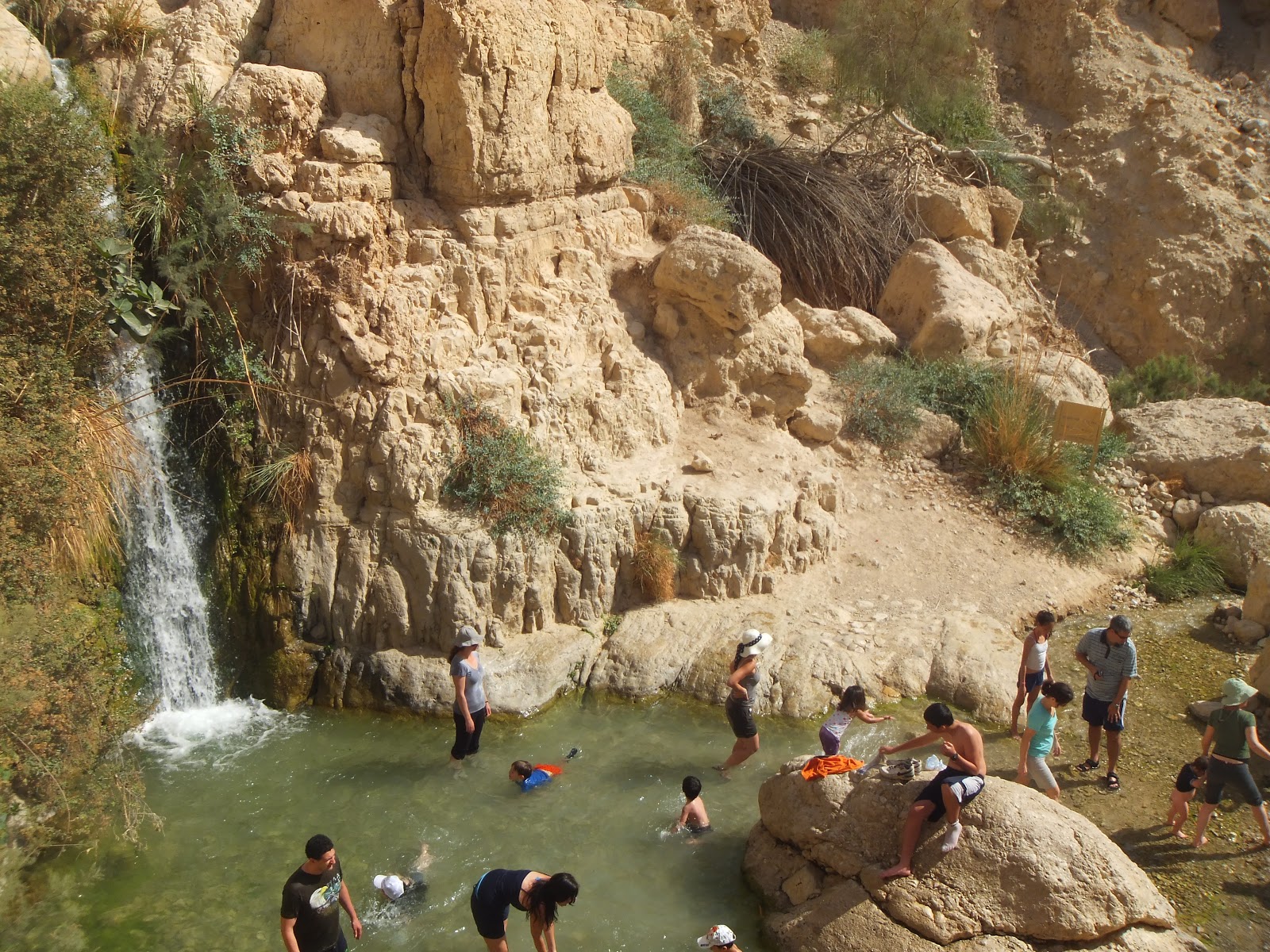
David Falls, a waterfall in the desert

numerous caves in the hill slope

Rock hyrex in the nature reserve

Nubian ibexes on the craggy rocks

Another view of David Falls

1 SAMUEL 24:1 After Saul returned from pursuing the Philistines, he was told, "David is in the Desert of En Gedi." 2 So Saul took three thousand chosen men from all Israel and set out to look for David and his men near the Crags of the Wild Goats.

    1SA 24:3 He came to the sheep pens along the way; a cave was there, and Saul went in to relieve himself. David and his men were far back in the cave. 4 The men said, "This is the day the LORD spoke of when he said to you, `I will give your enemy into your hands for you to deal with as you wish.' " Then David crept up unnoticed and cut off a corner of Saul's robe.

    1SA 24:5 Afterward, David was conscience-stricken for having cut off a corner of his robe. 6 He said to his men, "The LORD forbid that I should do such a thing to my master, the LORD's anointed, or lift my hand against him; for he is the anointed of the LORD." 7 With these words David rebuked his men and did not allow them to attack Saul. And Saul left the cave and went his way.

    1SA 24:8 Then David went out of the cave and called out to Saul, "My lord the king!" When Saul looked behind him, David bowed down and prostrated himself with his face to the ground. 9 He said to Saul, "Why do you listen when men say, `David is bent on harming you'? 10 This day you have seen with your own eyes how the LORD delivered you into my hands in the cave. Some urged me to kill you, but I spared you; I said, `I will not lift my hand against my master, because he is the LORD's anointed.' 11 See, my father, look at this piece of your robe in my hand! I cut off the corner of your robe but did not kill you. Now understand and recognize that I am not guilty of wrongdoing or rebellion. I have not wronged you, but you are hunting me down to take my life. 12 May the LORD judge between you and me. And may the LORD avenge the wrongs you have done to me, but my hand will not touch you. 13 As the old saying goes, `From evildoers come evil deeds,' so my hand will not touch you.


I have often wondered why David did not kill King Saul when he had a chance in Ein Gedi. This thought was on my mind as I walked the desert path to the waterfall. There were numerous caves on the mountain sides. In any of them, the incident narrated in 1 Samuel 24 could have taken place. After this incident, King Saul made peace with David. However, the king changed his mind and hunted David again. 1 Samuel 26 narrates another incident in which David could have killed King Saul, this time in the king's own camp but again did not.

David had all the excuses to kill Saul. He was exiled unjustly, repeatedly persecuted and hunted relentlessly by the king. David was able to escape Saul because of the desert and caves of regions such as Ein Gedi which afford good hiding places. In the two incidents, Saul was vulnerable and David's men has urged him to kill Saul. David has all the "right" reasons but he realized that to murder Saul was the "wrong" way. If David is to be king, he has to become king, not by murder but by God acting and placing him on the throne in God's way and by God's timing. David explained his reasoning in I Samuel 26: 23-24.

23 The LORD rewards every man for his righteousness and faithfulness. The LORD delivered you into my hands today, but I would not lay a hand on the LORD's anointed. 24 As surely as I valued your life today, so may the LORD value my life and deliver me from all trouble."

No matter how good the reasons are, it will be wrong to take God's justice in our own hands.Doing thing for the "right' reasons in the "wrong" way will not be pleasing to God. We, like David, have to discern how to do everything the right way for the right reasons.


During the Roman times, Ein Gedi was famous for its persimmon perfume. Marc Anthony, the lover of the Egyptian queen Cleopatra, confiscated the persimmon groves for her, but after her death king Herod leased them back. During the First Jewish War, the Jewish inhabitants of Ein Gedi tried to uproot the groves so they would not fall in Roman hands and  the Romans fought to prevent it. 

A few years before the destruction of Jerusalem in 70 CE, according to the Jewish historian Josephus Flavius, fanatic Zealots from Massada invaded the agricultural settlement of Ein Gedi. They stole all of the crops after killing 700 women and children, and returned with the spoils to their stronghold on Massada (War 4:401-4). After it was conquered by the Romans, Ein Gedi became quiet again, due to a Roman unit which enforced peace in the region.

During the Second Jewish War (130-135 CE), the famed leader of the Jewish rebels, Bar Kokhba, used Ein Gedi as his main administrative center. The Roman army crushed the rebellion and razed the town.

.

Labels: , , ,

Sunday, July 22, 2012

How to Overcome Discouragement


When all you know is discouragement
Seven ways to overcome discouragement


Sermon statement
The way to deal with discouragement is to take the word courage out and uses it. We overcome discouragement when we realise that (1) nothing happens according to our plans; (2) we need to be realistic in our expectations; (3) avoid dwelling on discouragements alone; (4) controlling our emotions; (5) not to give up; (6) that a closed door may leads to many open doors; and that our God is bigger than all our problems.

Introduction
Discouragement occurs when you did not get what you want. You may be hoping for a A++ grade in your exams and all you get is a A+ and you get discouraged. Your friend, who always has been getting Cs, getting a A+ is a great encouragement. What are some of the areas we experience discouragement?
  • Studies
  • Grades
  • Physical appearances
  • Spiritual life
  • Relationship
  • Friendship
  • Parents

Life of David
As a young man, David was a shepherd who was anointed king by the prophet Samuel. Saul was king then and it took many years before David could be king. David served as a musician to King Saul for many years. Even after he killed Goliath, David was not appreciated by King Saul. In his later life King Saul became increasing paranoid and even tried to kill David with a spear. David had to flee for his life and live a life of banditry.

Do you want to be king?
Later, as king, David had to rule over a nation of people who are self-centred and rebellious. Like today, evil men seem to be in control. King David faced threat to his life and his throne. It must be very discouraging to be king.


Text: Psalm 11:1-7

     Psalm 11

For the director of music. Of David.

  1 In the LORD I take refuge.
    How then can you say to me:
    "Flee like a bird to your mountain.

                 2 For look, the wicked bend their bows;
                 they set their arrows against the strings
                 to shoot from the shadows
                at the upright in heart.

 3 When the foundations are being destroyed,
                                 what can the righteous do?"

                                                                                        PS 11:4 The LORD is in his holy temple;
    the LORD is on his heavenly throne.
  He observes the sons of men;
    his eyes examine them.

                                5 The LORD examines the righteous,
                                but the wicked and those who love violence
                                his soul hates.

                 6 On the wicked he will rain
                fiery coals and burning sulfur;
                 a scorching wind will be their lot.

  7 For the LORD is righteous,
    he loves justice;
    upright men will see his face.


David expresses confidence in God even though wickedness appeared to be so very strong. David was facing a national crisis that threatened to overturn the stability of the nation of Israel. All around him, the moral foundations of the people were crumbling. This upheaval was caused by evil men who sought to do him harm. Adding to this ordeal, the people who were loyal to David panicked, counseling him to flee Jerusalem. But David remained calm and resolute, keeping his eyes on the Lord. In this hour of crisis, David determined to trust in God in spite of his circumstances. His faith, unshakable and unwavering, kept him steadfast in uncertain times.’

The psalm can be divided into two parts: the voice of discouragement (vv. 1–3) and David’s voice of courage (vv. 4–7). The first is the voice which David heard. The second is the voice with which he answered.

The voice of discouragement
The psalm begins with a note of surprise. David was trusting in the Lord in the midst of his trial (v. 1). Although his faith was well known to his friends, this did not keep them from grimly advising him to ‘Flee as a bird’ (v. 2).
To them it was all very clear. The wicked were ready to shoot ‘secretly’ (v. 2)—from the cover of darkness—at the godly.
David’s friends evidently considered his adversaries to be so numerous, so strong and so crafty that there was little hope of success against them. It appeared as if these enemies would cause the very foundations of society to be destroyed.
We often hear the same gloomy assessment that was given to David.

Wickedness is so strong and flourishing! The foundations are crumbling! All is hopeless! The righteous can do nothing to stem the tide!

3 When the foundations are being destroyed,
                                 what can the righteous do?"

David’s Response
David’s friends quite clearly expected one answer and one answer alone when they asked: ‘What can the righteous do?’ (v. 3). That answer was: nothing!
But David would have none of it! The very same logic offered to him on this occasion would have kept him from facing Goliath! David refused to yield to it then, and he here refuses it again. He does so for the very same reason, namely, his faith in God. The God who was greater than Goliath was also greater than the wicked who were seeking to destroy the foundations!
So David sets himself to remind his friends of certain key truths about God.
  • He is sovereign over all (v. 4a).
  • He is well aware of the wicked and what they are doing (v. 4b).
  • He is not ambivalent about evil but has the utmost hatred for it and in due time will bring judgment on the wicked (vv. 5–6).
  • He loves righteousness and smiles upon those who practice it (v. 7).

I believe that David has much to teach us about how to overcome discouragement even though we are not kings or queens. He can teach us how to take the courage out of discouragement.


Seven ways to overcome discouragement

1.      Nothing happens according to our plans (Prov. 21:31)
2.      Be realistic in our expectations (Prov. 24:3-4)
3.      Avoid dwelling on discouragements alone (Eccl. 4:9-12).
4.      Control your emotions (Prov. 25:28)
5.      Don’t give up (Gal. 6:9)
6.      A closed door may leads to many open doors (Gen. 50:20)
7.      Your God is bigger than your problems (Psalm 11)

1.      Nothing happens according to our plans (Prov. 21:31)
  PR 21:31 The horse is made ready for the day of battle,
    but victory rests with the LORD.

King David is a warrior-king and knows full well the power of the cavalry against the foot soldiers. The horse in these times will be equivalent of an Abrams tank today. Yet, the author of the proverb warns against being overconfident with our own planning. Basically ‘shit happens.’ Whatever can go wrong will go wrong.

Bruce Wayne in the first two Batman movies by Christopher Nolan has good intentions. He wants to fight crime in Gotham by becoming a legend of fear to the criminals. Unfortunately things did not go according to plans. In Batman Begins, the movie ended with his house burnt down. In The Dark Knight, Batman ended up being accursed as a murderer.

So we should expect things to go wrong in our lives, no matter how smart, rich or powerful we are. Things are going to go wrong. We are going to be discouraged. Discouragements are part and parcel of life. Expect discouragements and you will not be disappointed.

2.      Be realistic in our expectations (Prov. 24:3-4)
  PR 24:3 By wisdom a house is built,
    and through understanding it is established;
  PR 24:4 through knowledge its rooms are filled
    with rare and beautiful treasures.

Can we change reality to the way we want things to be? Inception is a 2010 British-American science fiction film with the elements of action heist, and thriller. Former architecture student Dominick "Dom" Cobb and business partner Arthur perform corporate espionage by dreaming and using an experimental military-developed machine to infiltrate the subconscious of their targets and extract information, their latest target being powerful Japanese businessman Saito. The movie suggests that we can change ourselves by implanting suggestions in our self conscious through our dreams. We all have a need to change ourselves. But we need to have a realistic expectation as to who or whom we change ourselves into.

Beauty and youth are two of the most lucrative commodity on earth today. Everyone wants to have the beauty and youthfulness of the models and movie stars. Is that a realistic expectation? We need wisdom to set realistic goals. Otherwise we will be setting ourselves up for a fall and discouragement.

3.      Avoid dwelling on discouragement alone (Eccl. 4:9-12)
  ECC 4:9 Two are better than one,
    because they have a good return for their work:
  ECC 4:10 If one falls down,
    his friend can help him up.
But pity the man who falls
    and has no one to help him up!
ECC 4:11 Also, if two lie down together, they will keep warm.
    But how can one keep warm alone?
ECC 4:12 Though one may be overpowered,
    two can defend themselves.
  A cord of three strands is not quickly broken.

Marvel's The Avengers is a 2012 American superhero film produced by Marvel Studios and distributed by Walt Disney Pictures, based on the Marvel Comics superhero team of the same name. In facing the onslaught of the army of Loki and Thanatos, the heroes and heroines found that that they need one another. Only in teamwork can their combined efforts defeat their enemies.

The presence of friends who will walk with us during our discouragement cannot be underestimated. The Preacher recognizes that and calls us to have friends.

4.      Control your emotions (Prov. 25:28)
  PR 25:28 Like a city whose walls are broken down
    is a man who lacks self-control.

The Incredible Hulk is a 2008 American superhero film based on the Marvel Comics character the Hulk. It is directed by Louis Leterrier and stars Edward Norton as Dr. Bruce Banner. It is the second film to be released in the Marvel Cinematic Universe and the fifth chronologically. This film establishes a new backstory where Banner becomes the Hulk as an unwitting pawn in a military scheme to reinvigorate the supersoldier program through gamma radiation. On the run, he attempts to cure himself of the Hulk before he is captured by General Thaddeus "Thunderbolt" Ross (William Hurt), but his worst fears are realized when power-hungry soldier Emil Blonsky (Tim Roth) becomes a similar but more bestial creature. Liv Tyler also stars as Betty Ross, Banner's love interest and General Ross' daughter. The hulk is pure rage.

If we look closely at our discouragement, we will find that feelings play a major role in expressing our not getting what we want. While there is a place for feelings (pain, sadness), there is also a place when we move beyond the feelings and look for possible solutions. Bruce Banner finds himself only when he learns to control his feelings and to integrate them.


5.      Don’t give up (Gal. 6:9)
9 Let us not become weary in doing good, for at the proper time we will reap a harvest if we do not give up.

The apostle Paul reminds us not to give up because if we persist, we will succeed. If our goals are realistic, then the chances of our success are good provided we do not give up. Po from Kung Fu Panda 1 & 2 is an arrogance panda. One of his redeeming characteristics is that he never gives up.

6.      A closed door may leads to many open doors (Gen. 50:20)
20 You intended to harm me, but God intended it for good to accomplish what is now being done, the saving of many lives.

These words, spoken by Joseph whose brothers sold him into slavery in Egypt illustrate this principle perfectly. If a closed door appears, instead of standing in front of it in self pity or trying to break it down, look around instead. There may be many open doors around.


7.      Your God is bigger than your problems (Psalm 11)
This principle brings us back to the text of this sermon which is based on Psalm 11. David is effectively saying that God is greater than all his problems and ours.

Conclusion

How do we deal with discouragement? Discouragement is part of life. We can choose to remain discouraged or we can pull the courage out of discouragement and uses it to continue with our lives.

I suggest these seven ways to deal with discouragement

1.      Nothing happens according to our plans (Prov. 21:31)
2.      Be realistic (Prov. 24:3-4)
3.      Avoid dwelling on discouragements alone (Eccl. 4:9-12).
4.      Control your emotions (Prov. 25:28)
5.      Don’t give up (Gal. 6:9)
6.      A closed door may leads to many open doors (Gen. 50:20)
7.      Your God is bigger than your problems (Psalm 11)

What says you?

Labels: , , ,