Wednesday, May 05, 2010

Movie Review on Shutter Island


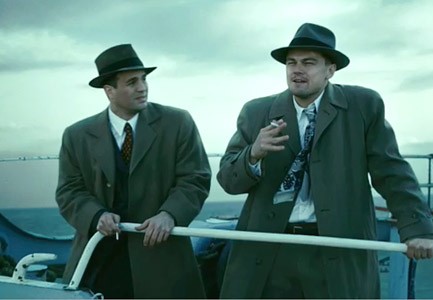
Martin Scorcese has a brilliant talent for creating tense movies with unexpected outcomes. This is another fascinating thriller with Leonardo DiCaprio as a federal marshal sent to investigate a disappearance in a mental institution.

Synopsis (from rottentomatoes.com):
Martin Scorsese and Leonardo DiCaprio team up for a fourth time for this adaptation of SHUTTER ISLAND, a novel by Dennis LeHane (MYSTIC RIVER). The film opens in 1954 as World War II veteran and current federal marshal Teddy Daniels (Leonardo DiCaprio) and his new partner, Chuck (Mark Ruffalo), ferry to Shutter Island, a water-bound mental hospital housing the criminally insane. They have been asked to investigate the disappearance of Rachel Solando (Emily Mortimer), a patient admitted to the asylum after she murdered her three children. As Teddy quizzes Dr. Cawley (Ben Kingsley), the head of the institution, he begins to suspect that the authorities in charge might not be giving him the whole truth, and that a terrible fate may befall all the patients in spooky Ward C -- a unit devoted to the most heinous of the hospital's inmates. Complicating matters further, Teddy has a secret of his own -- the arsonist who murdered his wife is incarcerated on Shutter Island. Driven to confront his wife's killer, and stranded on the island because of a hurricane, Teddy must unravel the secrets of the eerie place before succumbing to his own madness. Max von Sydow, Emily Mortimer, Michelle Williams, Patricia Clarkson, and Jackie Earle Haley round out the supporting cast.


{contain spoilers}

The mind is a fascinating organ and a powerful media in creating realities. The riveting way in which the story slowly unfolds with adequate clues along the way (if you are looking carefully) makes for an interesting movie, on par with A Dangerous Mind staring Russel Crowe. What is reality and how our minds may distort it is scary if we stop to think about it. In some ways, reality is what we make of it. Reality is built up by how we perceive the information received by our senses. What if somethings goes wrong with the process of perceiving? What if some trauma or injury distorts our perceiving? What type of reality do we then live in? And if one is caught in this reality, how can this person be helped.

In the movie, psychiatrist Dr. Cawley (Ben Kingsley) enters the psychotic reality of ex-federal marshal Teddy Daniels (Leonardo DiCaprio) in order to help him confront the truth and destroy the false reality he was caught in. Such delusional realities are very hard to break. By moving into Daniels' reality, Cawley reminds me of God who became man to move into our reality and break the bondage of sin. Only by his incarnation is our bondage to sin broken and we are able to perceive a new reality. Daniels' trauma is his murder of his wife and children and it is this that distort his perception of reality. His mind creates a reality for him to exist and escape from the pain that he feels.

I often wonder whether the reality that we exist in now is an illusion, created by our minds to escape the trauma of separation from God which is our sin. Now even when Jesus has come, we often, like Daniels in the movie, keep slipping back into his version of reality in order to escape the truth.

Another thought. Is it better to live and die pain-free in a reality which is an illusion or is it better to wake and face the pain of reality?

.

Labels: , ,

Monday, April 21, 2008

The Evangelical Mind


"The scandal of the evangelical mind is that there is not much of an evangelical mind"

Labels: , , ,

Wednesday, February 27, 2008

Scot McKnight's Hermeneutics Quiz

The Hermeneutics Quiz

Your biblical blind spots and what you tend not to see.

by Scot McKnight


For some reason of late, I have become fascinated with the portions of the Bible we don't tend to read, passages like the story of Jephthah. Or how God was on the verge of killing Moses for not circumcising his son, and his wife stepped in, did what needed to be done, and tossed the foreskin at Moses' feet, and God let him alone.
I'm curious why one of my friends dismisses the Friday-evening-to-Saturday-evening Sabbath observance as "not for us today" but insists that capital punishment can't be dismissed because it's in the Old Testament.


I have become fascinated with what goes on in our heads and our minds and our traditions (and the latter is far more significant than many of us recognize) in making decisions like this.
What decisions? Which passages not to read as normative. The passages we tend not to read at all.


If we're all subject to selective perception, at least to some degree, it's important to recognize what we tend to miss or gloss over, especially if we're church leaders.
This quiz is designed to surface the decisions we make, perhaps without thinking about them, and about how we both read our Bible and don't read our Bible. Some will want to quibble with distinctions or agree with more than one answer. No test like this can reveal all the nuances needed, but broad answers are enough to raise the key issues. On a scale of 1-5, mark the answer that best fits your approach to reading the Bible. (If you fall between response 1 and response 3, give yourself a 2.) Your score will reveal where you land on our hermeneutical scale.


Take the Hermeneutics Quiz

The scores divide you into conservative, moderate, and progressive.

My score is 61 which makes me a moderate. What's yours?

First, the conservative hermeneutic group scores 52 or lower. The strength of this view is its emphasis on the authority, ongoing and normative authority, of all of Scripture. It tends to operate with the line many of us learned in Sunday school: "If the Bible says it, that settles it." Such persons let the Bible challenge them with full force. Literal readings lead to rather literal applications. Most of the time. The problem, of course, is that very few people are completely consistent here. At times one suspects something other than strict interpretation is going on when the conservative is willing to appeal to history to suspend the commandment to observe a Saturday Sabbath, but does not to appeal to history on other issues (e.g., capital punishment or homosexuality).


The moderate hermeneutic might be seen as the voice of reason and open-mindedness. Moderates generally score between 53 to 65. Many are conservative on some issues and progressive on others. It intrigues that conservatives tend to be progressive on the same issues, while progressives tend to be conservative on the same issues. Nonetheless, moderates have a flexible hermeneutic that gives them the freedom to pick and choose on which issues they will be progressive or conservative. For that reason, moderates are more open to the charge of inconsistency. What impresses me most about moderates are the struggles they endure to render judgments on hermeneutical issues.


The progressive is not always progressive. Those who score 66 or more can be seen as leaning toward the progressive side, but the difference between at 66 and 92 is dramatic. Still, the progressive tends to see the Bible as historically shaped and culturally conditioned, and yet most still consider it the Word of God for today. Following a progressive hermeneutic, for the Word to speak in our day, one must interpret what the Bible said in its day and discern its pattern for revelation in order to apply it to our world. The strength, as with the moderate but even more so, is the challenge to examine what the Bible said in its day, and this means the progressives tend to be historians. But the problems for the progressives are predictable: Will the Bible's so-called "plain meaning" be given its due and authoritative force to challenge our world? Or will the Bible be swallowed by a quest to find modern analogies that sometimes minimize what the text clearly says?

read rest of article here

Labels: , ,

Tuesday, November 27, 2007

Developing Critical Thinkers

Brookfield, Stephen D. (1987) Developing Critical Thinkers: Challenging Adults to Explore Alternative Ways of Thinking and Acting. San Francisco: Jossey-Bass Publishers

Professor Brookfield from the Department of higher and Adult Education, Teachers College, Columbia University made a strong case for the teaching and use of critical thinking in adults outside the classroom. Apparently the teaching and use of critical thinking has not translated well to the workplace, politics, media and social lives of adults.
Critical thinking is defined by Brookfield as “reflecting on the assumptions underlying our and others’ ideas and actions, and contemplating alternative ways of thinking and living” (p.x). This he assumes is the way we “become adults.”

There are nine theses which Brookfield put forward in this book.

(1) Critical thinking is a positive activity that is total engagement with daily living.
(2) Critical thinking is an ongoing process, not an outcome.
(3) Critical thinking is closely linked to the context in which the process occurs.
(4) Critical thinking is triggered by life events, both positive and negative.
(5) Critical thinking involves the cognitive and the affective (emotive).
(6) Critical thinking is based on identifying and challenging assumptions.
(7) Critical thinking also challenges the importance of context.
(8) Critical thinking involves imagining and exploring alternatives.
(9) Critical thinking leads to reflective scepticism.


Other concepts closely related or similar to critical thinking are emancipatory thinking (Habermas), dialectical thinking (Riegel and Basseches), reflective learning (Boyd and Fales) and framing (Schon).

The key to critical thinking is our assumptions. To examine our assumptions, we must be aware of how much influence our culture, upbringing and social mores has on us. It is essential that we understand our assumptions in context. I agree with Brookfield that it is not something any of us are capable to doing by ourselves. Brookfield identified the trigger for critical thinking as positive or negative life events such as death, cancers, divorce, etc which forces us to re-evaluate our life situations. This is where critical thinking comes in. It challenges our assumptions and our context and then explores alternatives for us to live our lives. To Brookfield, a person who is a seasoned critical thinker is a reflective skeptic who takes nothing on face value.

There is a real need for many of us to develop critical thinking and examines issues that plague our countries and our churches.


.

Labels: ,