Monday, September 05, 2016

Regulating Stem Cells Treatment

Stem cells treatment are offered for many conditions such as rheumatoid arthritis, joint problems, retinal and optic nerves disease, Down's syndrome and multiple sclerosis. So far, conventional medicine uses stem cell for treatment in haematological conditions only. There are not many evidence-based studies on the efficacies of stem cells in other conditions. Yet, many clinics and practitioners offer stem cells therapies.

The FDA will hold hearings on stem cell treatment next year. Let us hope some useful guidelines will come out of this.

read more

http://www.wsj.com/articles/stem-cell-treatments-become-more-available-and-face-more-scrutiny-1472496352

.

Labels: ,

Monday, December 13, 2010

Stem Cells and Beauty Therapy

Finally, someone is speaking out on the fraudulent use of stem cells.

Therapy in session: Platelet-rich plasma being injected into the elbow.


Star online Monday, December 13, 2010

Credibility of stem cell therapy offered by cosmetic products

Many are falling prey to unscrupulous marketing tactics touting stem cell therapy as the new-age antidote for ageing.

From where it all stems

THE term “stem cell” was first proposed for scientific use by Russian histologist Alexander Maksimov in 1908.

Guidelines for stem cell treatment

Guidelines for stem cell research and therapy in Malaysia don’t apply to the beauty industry.

Labels: ,

Friday, December 03, 2010

Human Fatty Tissue as source of Stem Cells

Finally, there are news that regenerative medicine using stem cells are beginning to have practical applications. There has been a lot of hype about the enormous potential of stem cells which has yet to translate to clinical practice. This article highlights an important source of stem cells - from our fatty tissue. This sidestep the whole ethical and religious issue of using embryonic stem cells which are harvested from days old fertilised eggs (blastocytes). Fatty tissue are from adult adipose tissue and most of us have much to spare.


All Natural: Why Breasts Are the Key to the Future of Regenerative Medicine

Photo: David Slijper
Who needs implants? How tissue engineering and a new kind of stem cell can help the body rebuild itself.
Photo: David Slijper
To be in the company of Chris Calhoun is to encounter breasts, and encounter the damn things anytime, anywhere—including over a plate of spaghetti in a bustling Manhattan restaurant.
On this spring afternoon, the 44-year-old CEO of San Diego-based biotech company Cytori Therapeutics pulls out his laptop, launches a PowerPoint presentation, and there they are: conical and cantaloupy, As through Ds, beige and pink and taupe and tan, more breasts than you might see in a women’s locker room, never mind in the middle of a lunch table.
A passing waiter does a double take at this lively slide show, but Calhoun is oblivious. He’s talking excitedly about how these women’s bodies led him and his team of scientists to a discovery in tissue engineering, a process that could well be one of the most momentous medical advances of the 21st century: the use of stem cells—specifically stem-cell-enriched adipose (fat) tissue—to enhance, heal, and rebuild injured or damaged organs.

read more

.

Labels: ,

Tuesday, August 24, 2010

Wiki for Scientists

One of the commonest complaints of scientists and people involved in research is the amount of time spent on writing papers, submitting them to journals, waiting for the peer-reviewed paper to come back and to rewriting according to specifications before these papers are published. The various journals realize this time delay and have taken the step of publishing papers online before the hard-copy comes out. Many scientists think that more should or could be done. Scientist Fabio Casati suggests that scientists should just post their papers in their websites like a wiki. Information Society Technologies (ICT) reports,

Don’t print it; post it

Following the lead of physicists and mathematicians who for years have been posting early versions of their papers on a website called arXiv.com for quick dissemination and peer critiques, Casati and his colleagues propose that all scientists jump start the dissemination of their findings by posting them online.

“The idea is that when people write papers, they put them on their webpage quickly, easily and for zero cost,” Casati says.

At the same time, Casati suggests, every scientist and research group can create its own “liquid journal” which groups publications that are interesting and relevant to a given topic.

read more.

Online The Scientist journal adds to the discussion. One of the worries is whether the papers will be up to standard. Wikipedia who have millions of articles boost an accuracy rate compatible to the Britannica. Will it work with scientific papers? Can scientists police themselves and an 'invisible college' acts to maintain standards?
Image: Wikimedia commons, Gflores

Now, information engineer Fabio Casati of the University of Trento in Italy and his collaborators are suggesting science publishing try something entirely new, taking full advantage of the rapidly evolving Web 2.0 technology.

They suggest making research -- including formal manuscripts, datasets, presentation slides, and other presentations -- available through the web without any sort of traditional peer-review process. That research would then be searchable and citable by the rest of the scientific community at no cost.

"In this way -- by looking at what people do in terms of reading, sharing, or connecting scientific knowledge -- we can have a way of finding out which scientific resources are considered good and interesting by the scientific community," Casati said.

Specifically, he and his team envision a new age of scientific journals, created by the users themselves -- the scientists. "I [could] have my own journal, which I maintain on peer review, for example," he explains. "[When I find an interesting paper], I drag and drop the pdf file [in] the journal" using the platform provided by LiquidPublication, which recognizes the file, obtains the url, and retrieves the metadata, etc. "I do this because I want to keep track of it for myself [and alert] all my team, [but] by doing this, we also share [our thoughts on the research] with the world."

Read more

Labels: , , , , ,

Friday, May 14, 2010

Stem Cell Tourism

Stem cell therapy promises much hope to patients but there are very few proven and approved stem cell therapies at present. However, that do not stop some enterprising persons from setting up stem cells therapies centres and offering these treatments. I know of a few centres in Kuala Lumpur who offers such therapies. They have anecdotal evidence that they have 'cured' Down's syndome and cerebral palsy. My caution to parents who asked me about these stem cell therapies is that it is unproven and not acceptable as a therapy by modern medical care.

This is one of the articles from The American Journal of Bioethics. The May issue focus on stem cell therapy and stem cell tourism. It looks like transplant tourism now has a related sister.


Stem Cell Tourism and Doctors' Duties to Minors—A View From Canada
by Amy Zarzeczny, Timothy Caulfield
2010. The American Journal of Bioethics 10(5):3


Abstract/Extract
While the clinical promise of much stem cell research remains largely theoretical, patients are nonetheless pursuing unproven stem cell therapies in jurisdictions around the world—a phenomenon referred to as “stem cell tourism.” These treatments are generally advertised on a direct-to-consumer basis via the Internet. Research shows portrayals of stem cell medicine on such websites are overly optimistic and the claims made are unsubstantiated by published evidence. However, anecdotal evidence suggests that parents are pursing these “treatments” for their children, despite potential physical and financial risk. Physicians are in a unique position as they can be expected to be involved in, or privy to, such decisions. In this paper, we consider what duties physicians may have toward minor patients whose parents/guardians wish to engage in stem cell tourism on their behalf. We use the Canadian perspective to address the broadly relevant issues raised by this trend.

.

Labels: ,

Wednesday, April 14, 2010

TEDS: Growing Organs Engineering Tissues

TEDSMed2009


Speakers Anthony Atala: Urologist

Anthony Atala asks, "Can we grow organs instead of transplanting them?" His lab at the Wake Forest Institute for Regenerative Medicine is doing just that -- engineering tissues and whole organs (bladders and, soon, kidneys) using smart bio-materials and cutting-edge techniques.

Anthony Atala is the director of the Wake Forest Institute for Regenerative Medicine, where his work focuses on growing and regenerating tissues and organs. His team engineered the first lab-grown organ to be implanted into a human -- a bladder -- and is developing experimental fabrication technology that can "print" human tissue on demand.

In 2007, Atala and a team of Harvard University researchers showed that stem cells can be harvested from the amniotic fluid of pregnant women. This and other breakthroughs in the development of smart bio-materials and tissue fabrication technology promises to revolutionize the practice of medicine.

Labels: ,

Monday, December 21, 2009

Stem Cells to Treat Heart Attacks

I am glad to learn that there are some Phase 2 studies being done for stem cell therapies. After the great hype by stem cell research, it is time we see some useful applications. And this is from adult stem cells which makes most of the controversies about embryonic stem cells moot.

Stem cell therapies for hearts inching closer to wide use

By Elizabeth Landau, CNN
December 18, 2009 9:34 a.m. EST
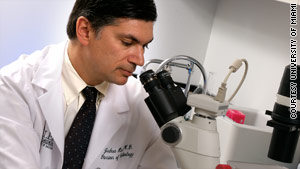
Dr. Joshua Hare at the University of Miami works on stem cell therapies for heart attack patients.

(CNN) -- If you've just had your first heart attack, doctors may one day be able to reverse the damage done with stem cell therapy.

An intravenous method of injecting stem cells into patients who had experienced heart attacks within the previous 10 days suggested that this method works to repair -- not just manage -- heart damage, a recent study found.


read more

Labels: ,

Thursday, February 05, 2009

Timely Information on Stem Cells

Some interesting updates about stem cell research especially as we look to a new era of scientific research under a new US President.

But today the field encompasses far more than just embryonic and adult stem cells; it has expanded into the broader field of regenerative medicine, and Melton's lab at Harvard is at the vanguard, bringing the newest type of stem cells, which do not rely on embryos at all, closer to the clinic, where patients will actually benefit. Last summer, Melton stunned the scientific community with yet another twist, finding a way to generate new populations of cells by reprogramming one type of fully mature cell so it simply became another, bypassing stem cells altogether.

read more


Related

Labels: , ,

Thursday, December 04, 2008

False Claims for Stem Cell Therapies

Recently I have noticed that there are more and more claims for unproven stem cells therapies. I know of a person in Kuala Lumpur who is using 'stem cells' to cure Downs syndrome. On Tuesday I sat through a hour long lecture by a small 'stem cell' therapy company trying to interest a major healthcare organisation on the benefits of stem cell research.

I am glad that the International Society for Stem Cell Research (ISSCR) task force has developed a new Guidelines for the Clinical Translation of Stem Cells which discusses core principles that should guide the responsible transition of basic stem cell research into appropriate clinical applications.

And here is an article from Cell Stem Cell journal which examines the marketing of unproven stem cell therapies.

Despite the immature state of stem cell medicine, patients are seeking and accessing putative stem cell therapies in an “early market” in which direct-to-consumer advertising via the internet likely plays an important role. We analyzed stem cell clinic websites and appraised the relevant published clinical evidence of stem cell therapies to address three questions about the direct-to-consumer portrayal of stem cell medicine in this early market: What sorts of therapies are being offered? How are they portrayed? Is there clinical evidence to support the use of these therapies? We found that the portrayal of stem cell medicine on provider websites is optimistic and unsubstantiated by peer-reviewed literature.

read more

Let the buyers beware.


.

Labels: ,

Monday, November 24, 2008

Trachea from Adult Stem Cells

From Christianity Today liveblog
November 20, 2008 12:32PM
Adult Stem Cells Score Again
A trachea engineered from bone marrow stem-cells makes ethical research more appealing.
Susan Wunderink


Claudia Castillo, whose lungs had been ravaged by tuberculosis, has a new trachea. She made it herself . . . sort of.


Doctors in Spain took stem-cells from Claudia Castillo's bone marrow and had them form a section of trachea based on the trachea of an organ donor. The scientists transplanted the 2.75-inch piece and published the results in The Lancet:

The graft immediately provided the recipient with a functional airway, improved her quality of life, and had a normal appearance and mechanical properties at 4 months. The patient had no anti-donor antibodies and was not on immunosuppressive drugs.
The results show that we can produce a cellular, tissue-engineered airway with mechanical properties that allow normal functioning, and which is free from the risks of rejection.

Castillo is the
first person to have an engineered trachea transplant, The Guardian says. She has had her new windpipe for several months without immunosuppressants—a breakthrough in surgery.

Besides giving hope to those who need transplants, Castillo’s case is also important to the debate over whether to allow stem-cell research which destroys embryos.

"Engineering new tissues and organs from stem cells has long been a goal of researchers, because it would help overcome a chronic shortage of donor organs.”
NPR says. “But controversies over the source of stem cells have slowed research in the United States."

However the transplant, rather than highlighting limitations, is another victory for ethical (and legal) stem-cell research. In its
Q&A on stem-cells, CNN says “In the past, because adult stem cells were considered stuck in their ways, the focus had been on embryonic cells but now scientists and doctors will be wanting to see if adult cells can be used to treat a wider range of conditions.”


.

Labels: , ,

Friday, October 10, 2008

The Stem Cell Debate

Ted Peters, 2007, The Stem Cell Debate, Minneapolis, MI: Fortress Press

Ted Peters teaches systematic theology at Pacific Lutheran Theological Seminary and the Graduate Theological Union in Berkeley, California. He is an associate of the Center for Theology and the Natural Sciences and is the co-editor of the center's journal Theology and Science.

Peters gives a good overview of the stem cell debate by framing the discussion into three frameworks:

(1) The embryo protection framework

The moral status of the ex vivo embryo (not implanted) and the principle of non-maleficience are central

(2) The nature protection framework

The fear that we may cross the line to manipulate genetics as in 'playing God'


(3) The medical benefits framework

Beneficience that puts relief of human suffering as the core of its reasoning

It is out of these three frameworks that a fourth will arise-The research standards framework which will essentially be government policies informed by the other three frameworks.


Peters essentially calls for more theologically informed ethicists to help people make the right decisions.

.

Labels: , , ,